

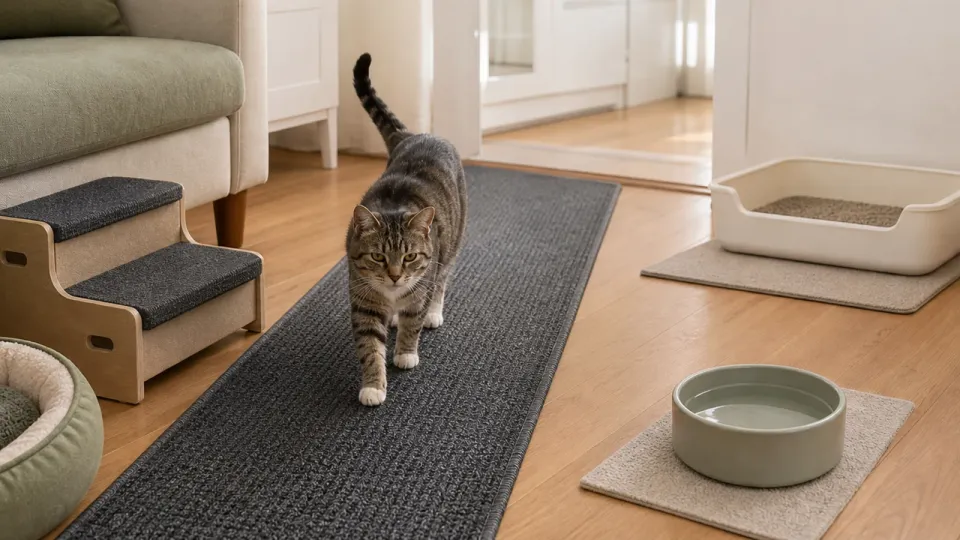
A senior cat home setup should make ordinary movement less expensive. The goal is not to turn the apartment into a clinic. It is to remove the little frictions that make an older cat jump higher, walk farther, cross slick floor, or choose between comfort and the litter box.
Most changes are small: a lower entry, a flatter path, a water bowl where the cat already rests, a step that does not wobble, a bed that does not require a leap. The hard part is noticing which part of the room has become costly before the cat starts avoiding it.
Start with the route your cat already uses
Do not begin by buying every senior-cat accessory. Watch the route first. Where does your cat sleep during the day? Where is the nearest water? How far is the litter box? Does the cat still jump to the sofa, or does she stand and calculate? Does she choose the rug path over the bare floor?
The Cornell Feline Health Center's senior cat guidance is a good reminder that aging can change daily needs even when a cat still looks like herself. Home setup should follow those daily changes instead of waiting for a dramatic decline.
In my senior-care notes, I mark the room by effort: jump, turn, climb, squeeze, stretch, cross, and retreat. The best first fix is often the one that removes the most repeated effort, not the one that looks most specialized.
Lower the litter entrance before accidents teach you the problem
The litter box is where aging friction becomes visible. A cat may still reach the box but hesitate at the side wall. She may step in with the front paws, pause, then leave. She may use the box only when the path is quiet, or choose a mat, towel, or floor spot that is easier to enter.
For a senior cat, a low-entry tray can matter more than a hidden tray, tall wall, or tidy enclosure. The cat needs enough room to enter, turn, posture, and exit without lifting sore hips higher than necessary. If you also need scatter control, add a forgiving mat outside the box rather than making the entry harder.
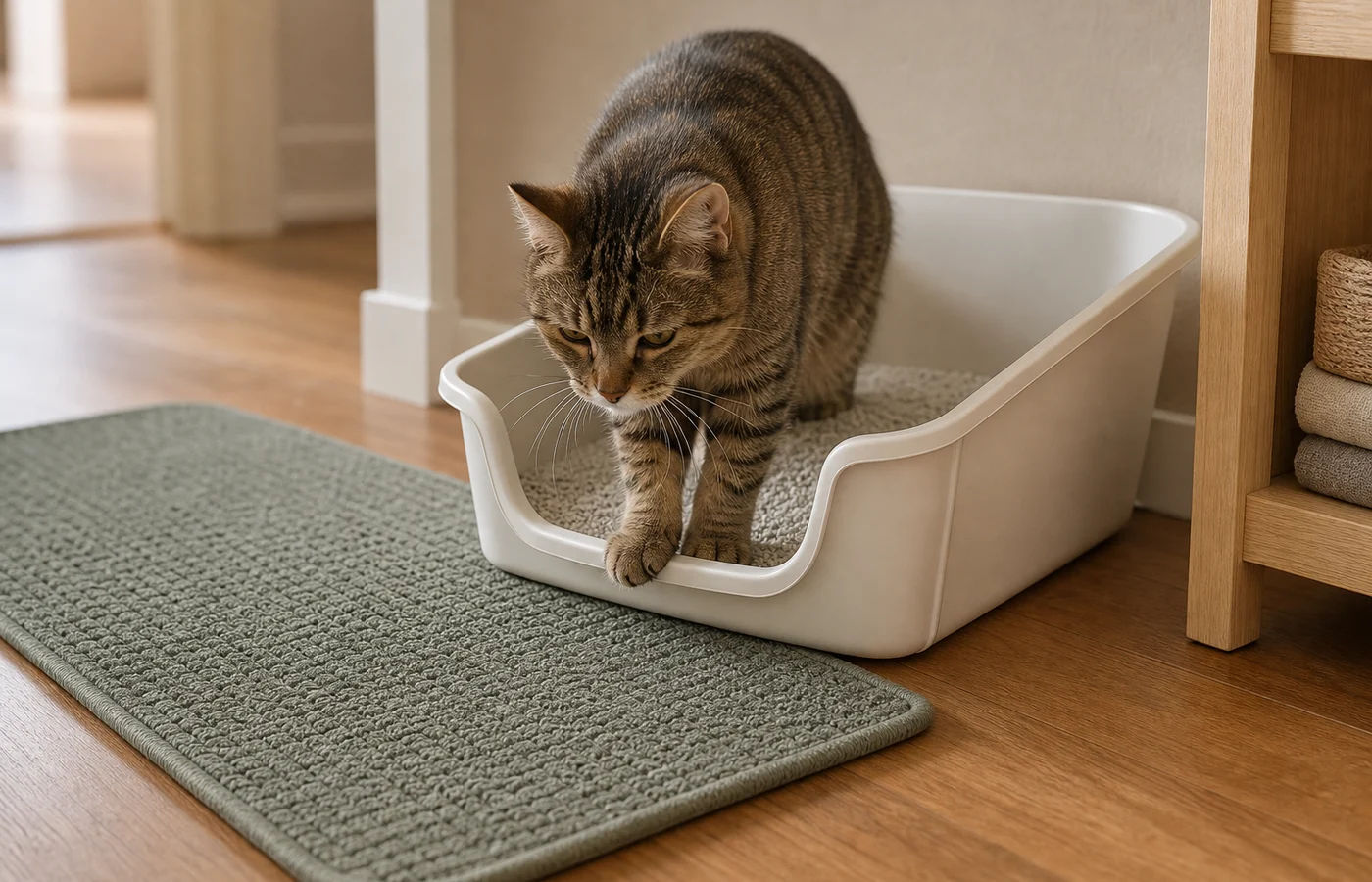
If the issue is sudden, painful, or paired with straining, crying, blood, frequent trips, or little urine, stop treating it as a setup project. The Cornell Feline Health Center's house-soiling resource explains that litter box problems can involve medical, environmental, and behavioral causes. A senior cat deserves the medical question first when elimination changes quickly.
Put essentials on the same floor
Stairs change the math for older cats. A water bowl upstairs may be technically available and still be too far from the cat's resting routine. A litter box in the basement may have worked for years and then become the box the cat uses only when she has no easier option.
Place one set of essentials where your cat spends most of the day: water, a comfortable resting spot, an easy litter route, and a safe place to retreat. In a small apartment, that may mean separating resources by a few calm feet rather than across rooms. In a two-story home, it may mean duplicating the litter and water access so stairs are not the price of basic needs.
This is where a broader cat-proof home setup mindset helps. Clear cords, stable furniture, and predictable routes are not just kitten issues. They also decide whether an older cat can move without slipping, squeezing, or being startled.
Make the floor easier to trust
Hard floors can be beautiful for people and uncertain for cats who are less strong through the back legs. Watch for small signs: a cat walking close to walls, jumping down then skidding, avoiding a glossy hallway, or choosing rugs even when the route is longer.
Use low-profile, non-slip runners on the routes that matter most: bed to water, bed to litter, sofa to floor, hallway to favorite window. Avoid thick mats with curled edges. A trip hazard is not a senior-friendly upgrade just because it is soft.
Keep paths boring. Move baskets, shoes, toys, and storage bins out of the narrow routes. A younger cat may flow around clutter. An older cat may hesitate, jump over it, or avoid the route entirely.
Steps should be broad, stable, and worth using
A step or ramp helps only if the cat trusts it. Narrow steps, slick treads, lightweight foam blocks, or wobbly boxes can make the route feel less safe than the original jump. The best assist is usually low, broad, grippy, and placed where the cat already tries to go.
The VCA arthritis in cats guidance notes that cats may show pain through changes in jumping, climbing, play, grooming, mood, or litter box use. That does not mean every missed jump is arthritis, but it does mean changes in movement deserve attention instead of being dismissed as laziness.
Test a step without forcing it. Put it beside the sofa, bed, or window perch, then watch whether the cat chooses it when the room is calm. If she jumps around it, the step may be too steep, too narrow, too slippery, or simply in the wrong place.
Water and rest should be close without crowding the cat
Older cats often benefit from shorter resource routes. That does not mean everything should be clustered into one cramped corner. Water should be easy to reach, stable, and away from litter. Resting spots should be low enough to enter without a leap and warm enough to invite use.
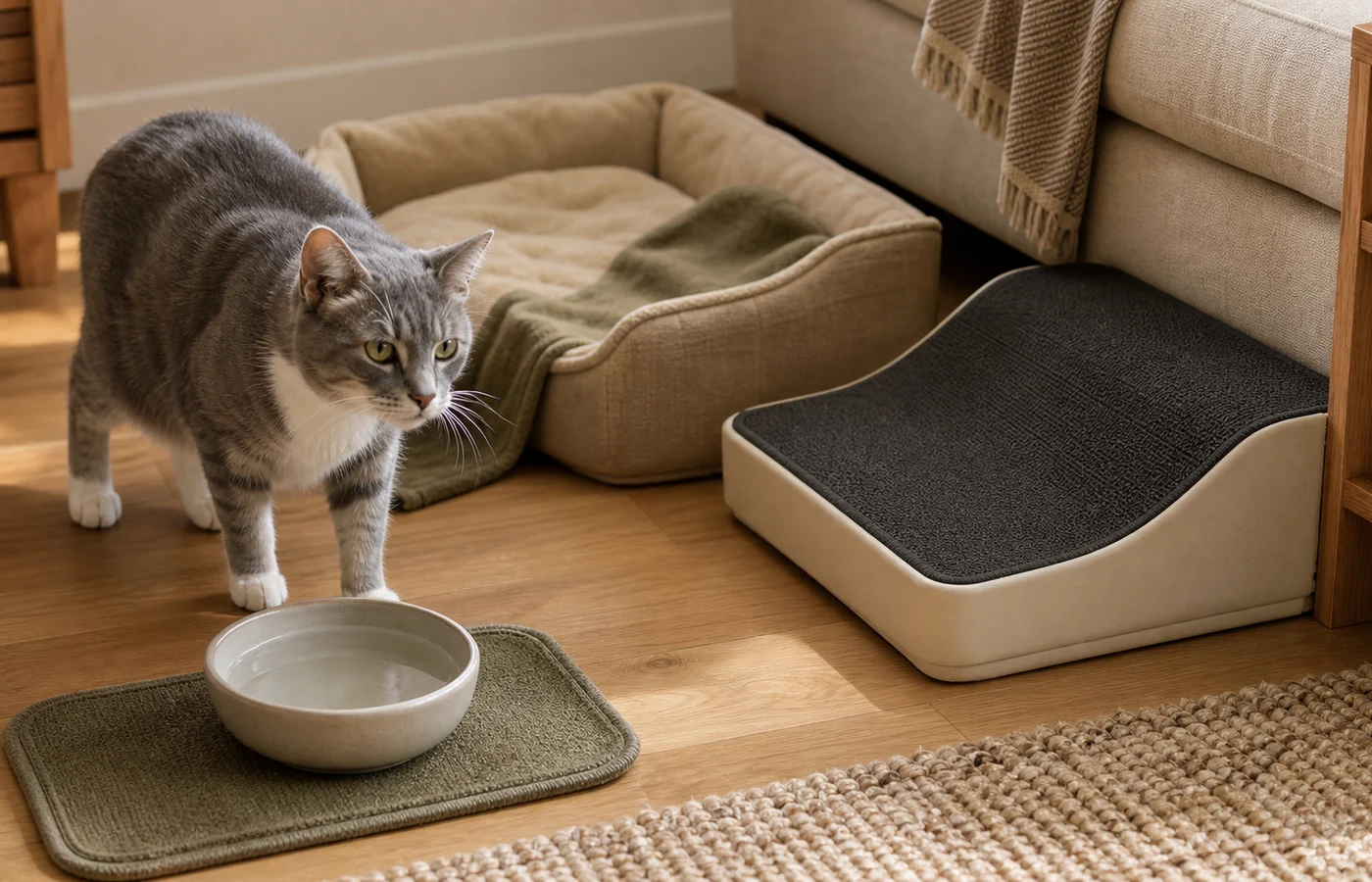
Use shallow bowls if whisker contact seems to bother the cat, and place water where it will not be kicked, blocked by a door, or ignored because another cat controls the route. If hydration, appetite, weight, or urination changes, treat that as a health signal rather than a bowl-location puzzle. Cat & Meow's cat health pages should support observation, not replace veterinary care.
Keep the favorite places, but reduce the cost
A senior setup should not erase the cat's territory. If the favorite nap is the sofa, add a step. If the favorite view is a low window, make the landing stable and check the screen. If the favorite sun patch is on a slick floor, add a flat runner or washable bed.
The mistake is moving every resource to the most convenient place for the person. Older cats can be sensitive to sudden layout changes. Shift one thing at a time and keep a familiar scent path when possible. A washable bed can move closer to the floor before you remove the old perch entirely.
If the cat no longer reaches a high window comfortably, do not turn that into a daily test. Lower the viewing option. A safe, reachable perch beats a dramatic perch the cat visits once and avoids.
Cleanliness should not require awkward lifting
Senior-care changes need to be sustainable for the person too. A low-entry box that is hard to scoop, a heavy water station that gets skipped, or a bed that cannot be washed will not stay helpful for long. Choose simple surfaces and placements that can be cleaned without pulling the whole room apart.
That matters because older cats may be less tolerant of dirty resources. A stale box, slippery water spill, or dusty mat can push a cat away from a route she was barely accepting. Keep the daily path clean enough that the cat does not have to choose between comfort and hygiene.
For litter areas, think in reach and routine: can you scoop without moving the box, wash the mat, and keep the entrance clear? If the answer is no, the setup is too complicated even if it looks tidy.
Know which changes belong with a veterinarian
Home setup can reduce strain. It cannot diagnose pain, kidney disease, arthritis, cognitive change, urinary disease, dental disease, or appetite problems. The Cat Friendly Homes senior care resource emphasizes regular veterinary care and close observation as cats age. That is the right boundary for this kind of article.
Call a veterinarian if your senior cat has sudden litter box misses, straining, repeated box trips, blood in urine or stool, rapid weight change, appetite change, increased thirst, hiding, confusion, new aggression, difficulty jumping, or a movement change that persists. Do not wait for the home setup to prove itself when the body may be asking for help.
After medical concerns are addressed, the setup still matters. Lower entrances, shorter routes, stable steps, washable beds, and non-slip paths make daily life easier. They are not a cure. They are the room doing its part.
The best senior setup feels uneventful
A good senior cat home setup does not call attention to itself. The cat simply uses the litter box without calculating the entry, drinks without crossing the whole home, reaches the sofa without a hard jump, and walks across the room without sliding.
That is the test I trust most. If the room creates fewer pauses, fewer detours, and fewer risky jumps, the setup is working. The upgrades may look modest, but for an older cat, modest is often exactly the point.