

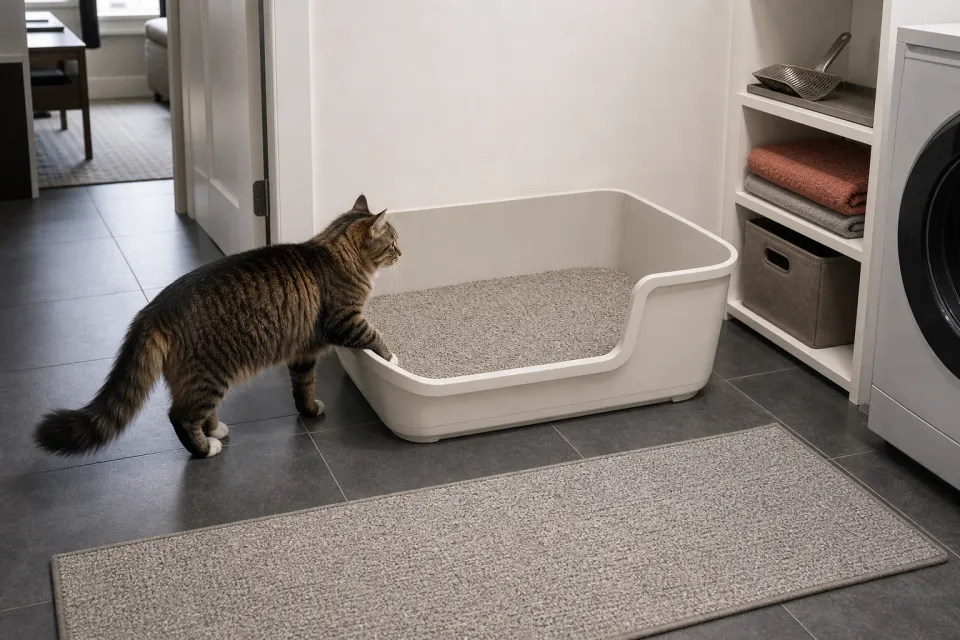
A large cat litter box is not just a bigger plastic tray. It has to let the cat enter without bracing, turn without folding, dig without hitting the walls, and leave without throwing litter across the room. If the box is only large on the outside, the cat may still be working inside a cramped bathroom.
I look at a large-box setup in the same order every time: inside floor space, entry height, wall height, turning path, then the room around it. A box that gets those five things right usually works better than a stylish box that hides well but asks the cat to squeeze, climb, or twist.
The box has to fit the cat in motion
The easiest mistake is measuring a cat while she is sitting still. Litter box use is movement. The cat steps in, lowers the front half, turns, digs, postures, pivots, covers, and exits. A long cat needs more length. A broad cat needs more shoulder room. A stiff cat needs a simpler path.
Merck Veterinary Manual frames litter box success around access, location, cleanliness, and cat preference. Size belongs inside that access question. A cat may technically fit in a box and still dislike using it because every turn is tight.
Watch the body, not the label. "Large" on a product page can mean a longer rim, taller walls, a covered shell, or a wider footprint. What matters is the open interior floor area your cat can actually use.
Measure usable space, not the outside shell
The outside dimensions on a box rarely tell the whole story. Rolled rims, sloped walls, a thick lid track, curved corners, and molded handles can steal the space your cat needs most. A box can look extra large in the store and still give the cat only a narrow standing lane once litter is inside.
Use a simple visual check instead of chasing exact numbers. After the box is filled to its normal depth, the cat should have visible room around the shoulders and hips while standing naturally. The entry should not force a sideways squeeze. The back wall should not be the only place the cat can posture. The tail should not sweep every surface during an ordinary turn.
This is where many "large" boxes fail in real rooms. The owner buys more plastic, but the cat still gets a cramped corner, a high step, or a covered doorway. The practical question is whether the usable floor and the route around it got easier.
Turnaround space is the first real test
A fair box lets a cat turn in a normal arc instead of backing out, stepping on the edge, or planting paws half on the wall. In my notes, the clearest warning signs are simple: the tail sweeps the rim, shoulders bump both sides, the cat circles twice before settling, or the front paws leave the box while the back half is still inside.
A bigger box can also change digging behavior. Cats who have enough room often dig and cover with fewer awkward wall hits. Cats who are cramped may kick litter out, leave waste uncovered, or rush the exit. Those signs are not always attitude; sometimes the box is asking for bad mechanics.
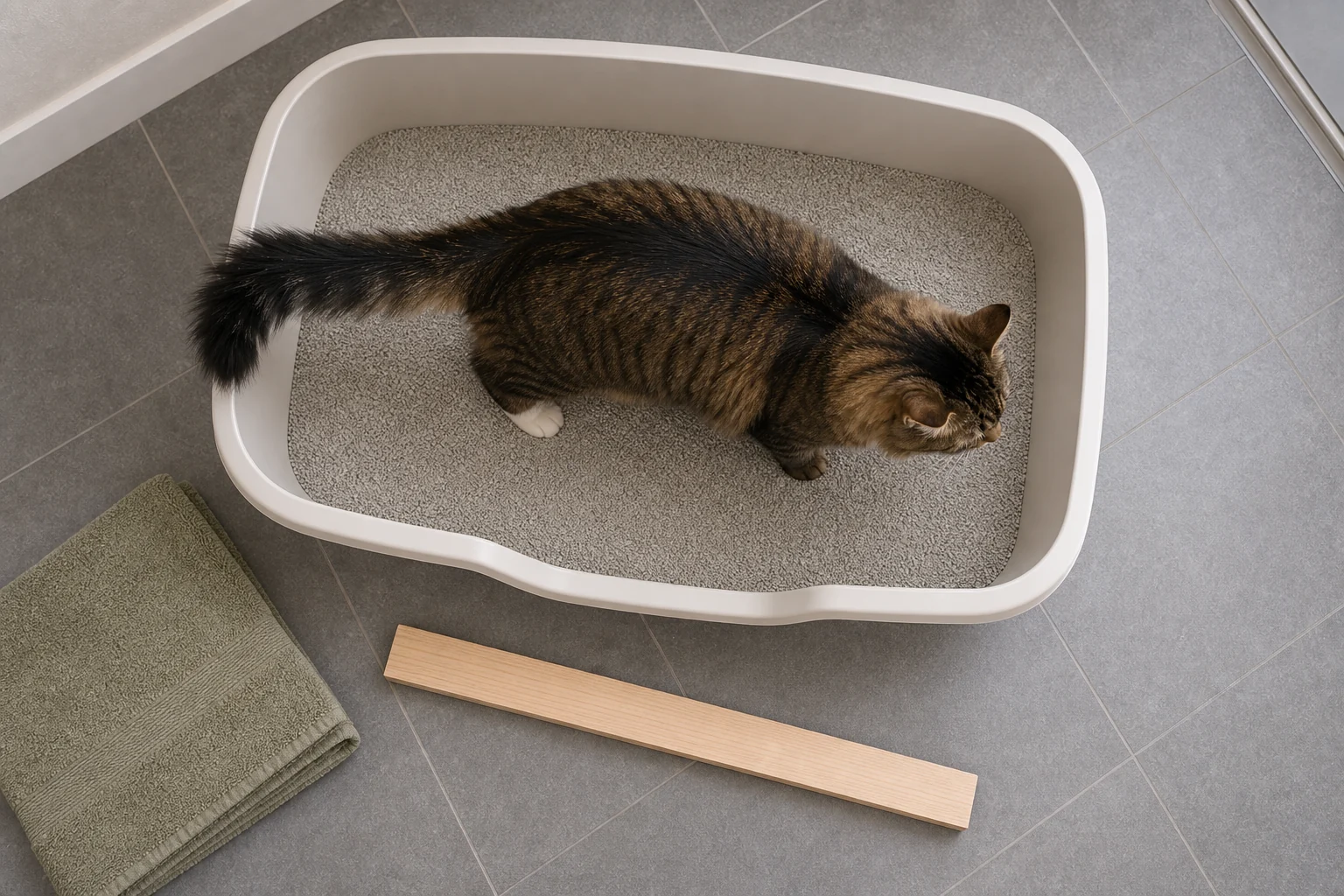
If a box only works when it is nearly empty, it is too tight. Litter depth takes up usable height, and wall shape can steal corners. Rounded interiors, rolled rims, and deep curves may look comfortable but still reduce the floor space a large cat needs.
Low entry and high sides solve different problems
Entry height and wall height are not the same decision. A low front entry helps cats step in without a jump, which matters for large cats, senior cats, kittens, and cats with sore joints. Higher side or back walls help contain digging and urine overspray. The useful design often combines both: low where the cat enters, taller where litter needs containment.
The ASPCA litter box problem guidance warns that openings and sides can be difficult for some cats, especially when age or health changes are involved. A high-walled box is not automatically cat-friendly just because it keeps the floor cleaner.
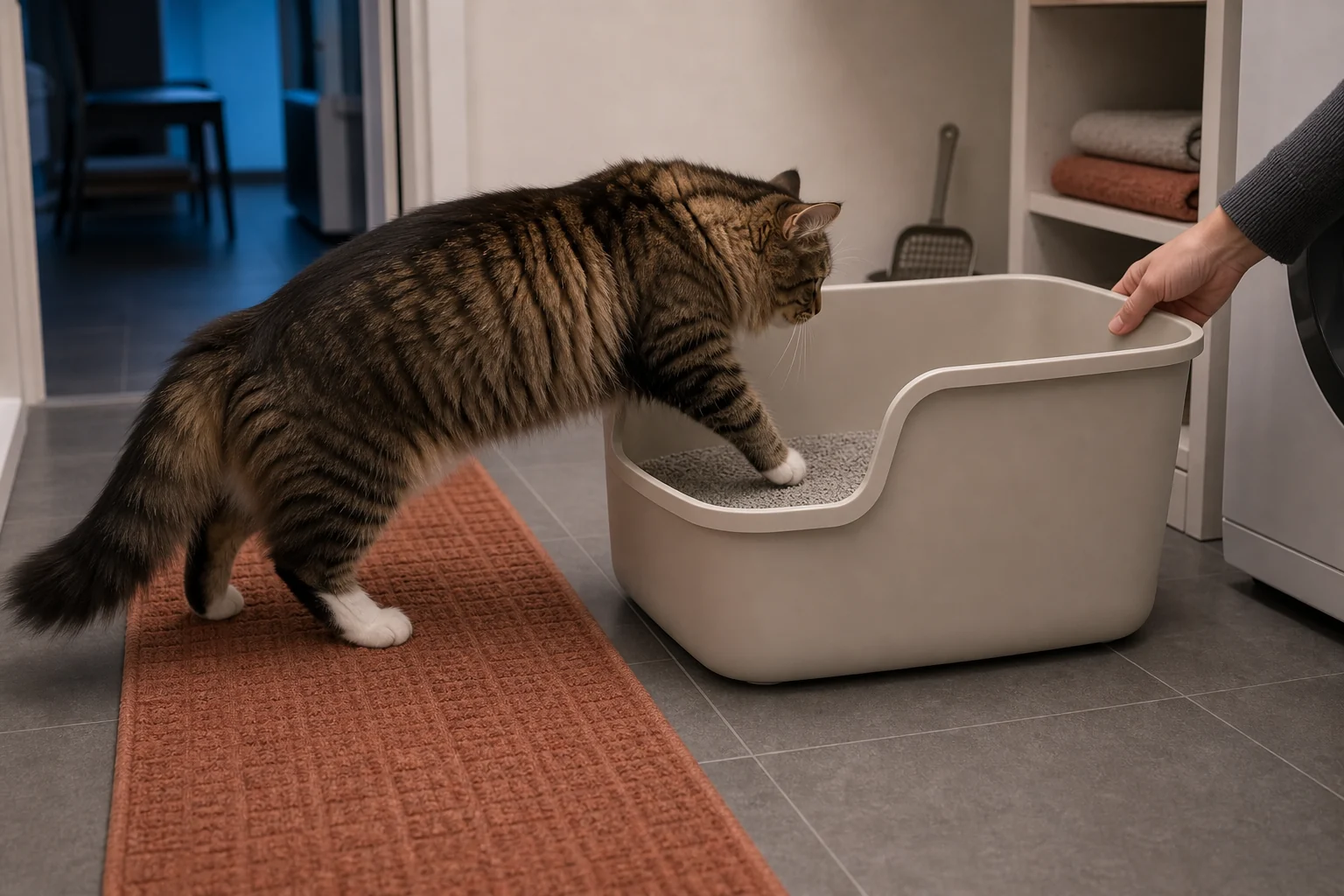
If the cat has to hop into the box, the entry may be too high. If the cat has to squeeze through a cutout, the entry may be too narrow. If the front is low but the box slides when the cat steps in, the setup still fails. Stability counts as access.
Covered boxes can shrink a large box fast
A covered box may have a large footprint but a smaller usable interior. The lid, doorway, rim, rounded corners, and low ceiling can turn a big-looking box into a tight tunnel. That is especially noticeable for long cats and cats who stand tall while urinating or covering.
Covered styles can still work for some cats, but the cat gets the vote. If your reason for choosing a cover is odor hiding or appearance, compare that against airflow, cleaning, and entry comfort in covered vs open litter box. For a large cat, open space usually deserves more weight than furniture-like concealment.
Watch the exit. A cat who bursts out of a covered box may scatter more litter than a cat calmly leaving a large open tray. Tracking is partly a box-size issue, but it also belongs to the mat and exit path beyond the box.
The room around the box has to fit too
A large cat litter box can fail in a too-small location. If the tray sits behind a door, between laundry baskets, inside a narrow closet, or beside a noisy machine, the usable space shrinks before the cat even steps in. The cat needs room to approach, pause, enter, turn, and leave without being cornered.
The Ohio State Indoor Pet Initiative treats litter boxes as important indoor resources that should be easy to locate and use. That is a practical reminder for large boxes: do not improve the tray and then trap it in a poor route.
Apartment setups need special care. A larger tray may take floor space from a hallway, bathroom, or laundry nook. That is still better than a compact box the cat avoids, but it means the room plan matters. If storage, odor, and walking paths are all competing, solve the broader small-space litter setup instead of forcing the largest tray into the worst corner.
Litter depth changes the feel of size
Adding more litter does not always make a large box better. Deep litter can help some cats dig, but it can also raise the step, shift under heavy paws, and reduce wall clearance. A cat who sinks, slips, or has to climb through a high front edge may avoid a box that looked generous when it was empty.
Test depth with normal use. After scooping, look for where the cat stands, where clumps form, and whether litter is piled against one wall. If the cat always uses the same cramped corner, the box may be poorly placed, too narrow, or hard to turn in. If the whole box smells after normal scooping, the issue may be residue, clump breakage, airflow, or waste storage rather than footprint. That belongs with an odor source check, not another size change.
Senior and painful cats need the easiest version
Large cats are not the only cats who need more room. Senior cats and cats with arthritis may need a large box because turning is harder, not because their body is bigger. The VCA arthritis resource notes that cats can hide pain and show changes in jumping, mobility, grooming, or litter box behavior. A box that was fine last year may become too tall or too tight.
For a cat with mobility concerns, prioritize low entry, stable floor, open top, and a clear path. Put the box where the cat already travels, not at the end of a difficult route. If misses, straining, frequent trips, crying, blood, sudden avoidance, or appetite changes appear, stop treating the box as a setup problem. The Cornell Feline Health Center explains that house soiling can involve medical, environmental, and behavioral causes.
A practical fit check beats the label
Before committing to a large cat litter box, set it up where it will actually live and watch ordinary use for a week. Keep the old box available if this is a change, especially for a senior cat, multi-cat home, or cat with a history of misses. Do not force the test by making the old box unpleasant.
The right large box should make the cat look unremarkable. She enters without climbing effort, turns without bumping every wall, digs without fighting the rim, covers without rushing, and leaves on a predictable path. The room should also be easier for you to maintain. If the box is hard to scoop, awkward to wash, or too large to keep in a sensible location, the setup may not last.
Choose the box that keeps the bathroom easy for the cat first. The floor, mat, storage, and cleaning routine can adjust around that. A tidy corner matters, but not as much as a box your cat can use comfortably every day.