

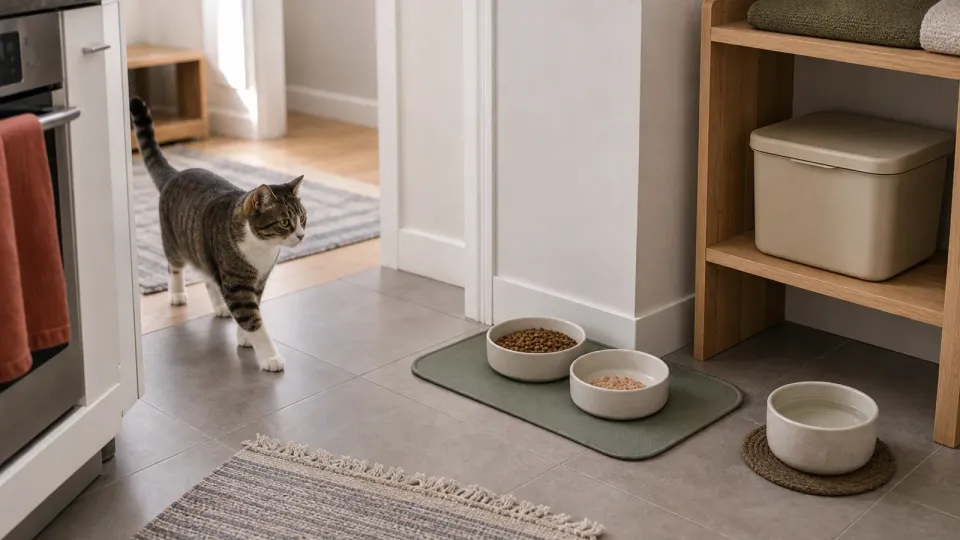
A cat feeding station looks simple until the bowls end up in the wrong traffic lane, the water gets ignored, the food bin lives too far away, and the floor under the mat becomes the place nobody wants to clean. The setup is not only about what the cat eats. It is about where the routine happens.
When I plan a feeding station, I start with the route: where the cat approaches, where people walk, where water can sit without being crowded, and where food can be stored without becoming a daily mess. Good placement makes meals calmer and cleanup less negotiable.
The station needs a job before it needs a style
A feeding station has three jobs. It should make food easy for the cat to access, keep water available and clean, and make the human routine simple enough to repeat. A matching bowl set does not fix a station that blocks a doorway or puts food beside the litter area.
The Ohio State Indoor Pet Initiative frames food, water, litter, scratching, resting, and play as indoor resources. That resource lens helps. The feeding station should not compete with the litter box, a noisy appliance, a dog path, or the only route through the kitchen.
In a small apartment, the best spot is often a quiet edge of the kitchen, a hallway nook with low traffic, or a wall section where the cat can approach and leave without being stepped over. Avoid corners where the cat has to eat with her back trapped against foot traffic.
Separate food and water enough to make both readable
Many homes put food and water shoulder to shoulder because it looks tidy. Some cats still drink there. Others drink more reliably when water has its own clean space away from food smell, crumbs, and whisker traffic. You do not need a dramatic separation; even a short offset can make the station easier to read.
Place water where it will be refilled and washed, not where it disappears behind a bin. If the cat already uses a separate water spot, do not collapse it into the food mat for convenience. A feeding station should support the cat's drinking pattern, not erase it because the set looks neater in one line.
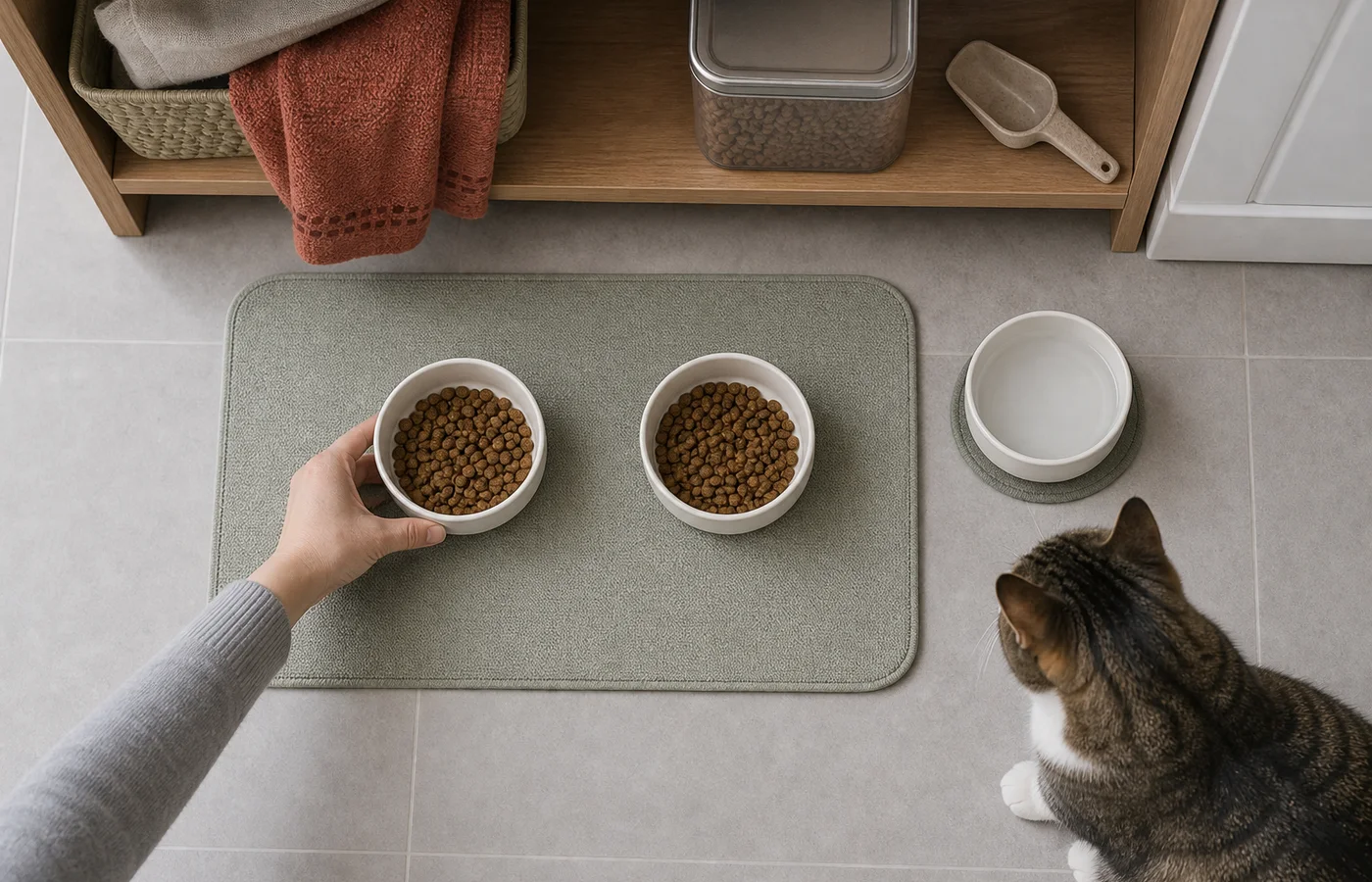
If you are already working on hydration, treat the water side as its own resource. The broader cat food path can cover food routines, but the water bowl still deserves a route, a cleaning rhythm, and a backup plan when the main bowl gets dirty.
Shallow and steady beats fancy and cramped
Bowls should be easy to reach, easy to wash, and steady on the floor. Shallow dishes often make eating more comfortable because the cat does not have to push the face deep into a narrow cup. Heavy ceramic or stainless bowls can also be easier to keep stable than lightweight bowls that slide across tile.
The Cornell Feline Health Center's feeding overview discusses feeding as part of a cat's health and daily care. For a setup article, the practical boundary is clear: bowl placement and routine can support meals, but diet type, portions, and medical feeding decisions still belong with veterinary guidance.
Raised stands, tilted bowls, slow feeders, and mats can all be useful in the right situation. They can also make the station harder to clean or harder for the cat to use. Add one change at a time. If the cat backs away, paws food out, eats only from one side, or leaves more mess than before, the setup may be working against her.
Food storage belongs close enough to be used correctly
Storage is part of the feeding station because it decides what happens on tired nights. If the scoop, lid, and bin are nearby, food gets closed, measured, and put away. If the bag is across the room, it may stay open, spill crumbs, or become a pantry object the cat investigates.
Use a sealed container or keep food in its original bag inside a sealed bin, depending on how you manage labels and lot information. Avoid decorative jars that make it hard to identify the food later. The setup should be tidy without separating the food from the information people may need if there is a recall, sensitivity question, or vet discussion.
I also like storage that can be opened with one hand while the bowls are already on the counter or mat. If the lid is awkward, the scoop has no home, or the container has to be dragged across the floor, the station will slowly train people to take shortcuts.
Keep storage away from heat, damp floors, cleaning chemicals, and direct sun. A lower shelf near the station can work when it stays dry, closes securely, and does not block the cat's approach.
Cleaning access decides whether the station stays healthy
A feeding station that is annoying to clean will not stay clean. Bowls need washing. Mats collect crumbs and moisture. The floor under the mat can hold odor. A water spill can travel under a cabinet toe-kick before anyone notices.
The CDC's pet food safety guidance emphasizes safe handling, storage, and cleaning habits. For a home setup, that means the station should make those habits easy: bowls that fit the sink, a mat that lifts, a floor that wipes, and storage that closes.
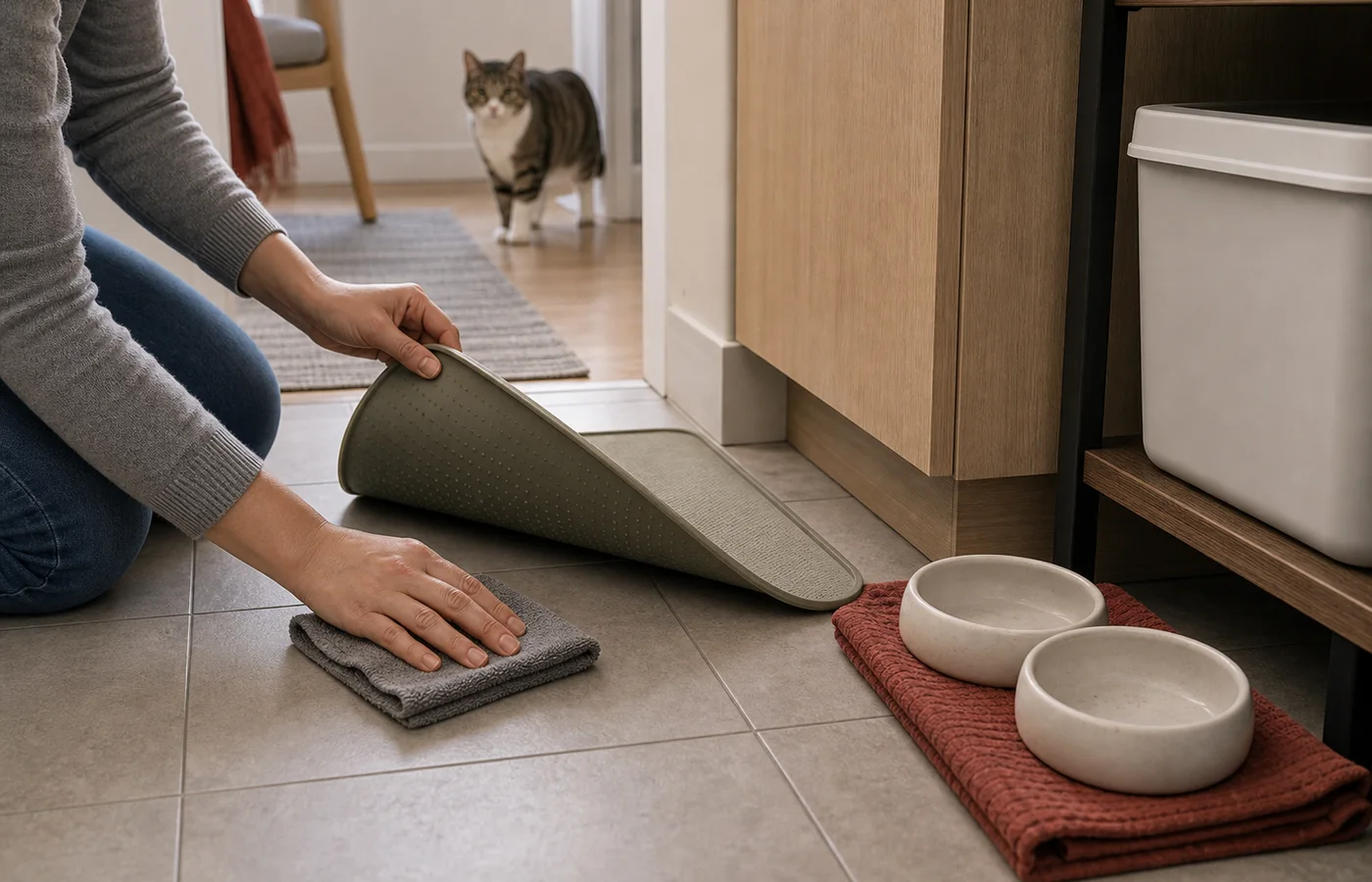
Leave room for the cleaning motion. Can you pick up the bowls without stepping over the cat? Can the mat dry fully? Can the food bin open without hitting the water bowl? These small details are what keep the station from becoming a sticky corner.
Traffic flow matters more than the neatest wall
Cats often prefer to eat where they can monitor the room without being bumped. A station in a busy doorway may seem efficient for people and stressful for the cat. A station under a chair may seem tucked away and still put the cat in a place where feet move unpredictably.
Watch one ordinary meal. Does the cat keep looking over her shoulder? Does someone step around her every morning? Does another pet pass close enough to make her hurry? Move the bowls before you assume the food is the issue.
The same traffic thinking belongs in broader cat-proof apartment setup. Food, water, cords, door swings, storage, and walking routes all interact. A feeding station should fit the home without making the cat eat in the middle of the household's busiest lane.
Multi-cat homes need exits and separation
Two bowls side by side may feed two cats on paper and still create tension in the room. One cat can hover, stare, rush a bowl, or control the exit. Another cat may eat too fast, leave early, or avoid the station when the confident cat is nearby.
Separate bowls by more than a few inches when possible. Use different sides of a room, different time windows, or different stations if one cat guards the area. In tight apartments, even a corner angle or a second mat can help each cat approach without nose-to-nose pressure.
This is especially important when food routines overlap with litter routes. Keep the feeding station away from the litter box and from the main exit path. The practical small-space thinking used for a small-space litter setup also applies here: separate resources so the cat does not have to choose between eating and feeling safe.
Run a one-week feeding station reset
Before buying a full station, run a simple reset. Put food bowls where the cat can approach calmly. Move water slightly away. Put storage close enough that the lid actually closes every time. Choose a mat you can lift. Watch the route at breakfast, dinner, and late-night refills.
The station is working when meals look ordinary: the cat approaches without hesitation, eats without rushing from traffic, water gets cleaned and refilled, the floor stays easy to wipe, and the food container closes after each use. It is not working when the cat avoids the spot, spills increase, water gets ignored, or people keep stepping over the bowls.
A cat feeding station should make the daily routine calmer, not more decorative. Start with placement, separation, storage, and cleaning. Once those work, the bowl set can be whatever fits the cat and the room.