

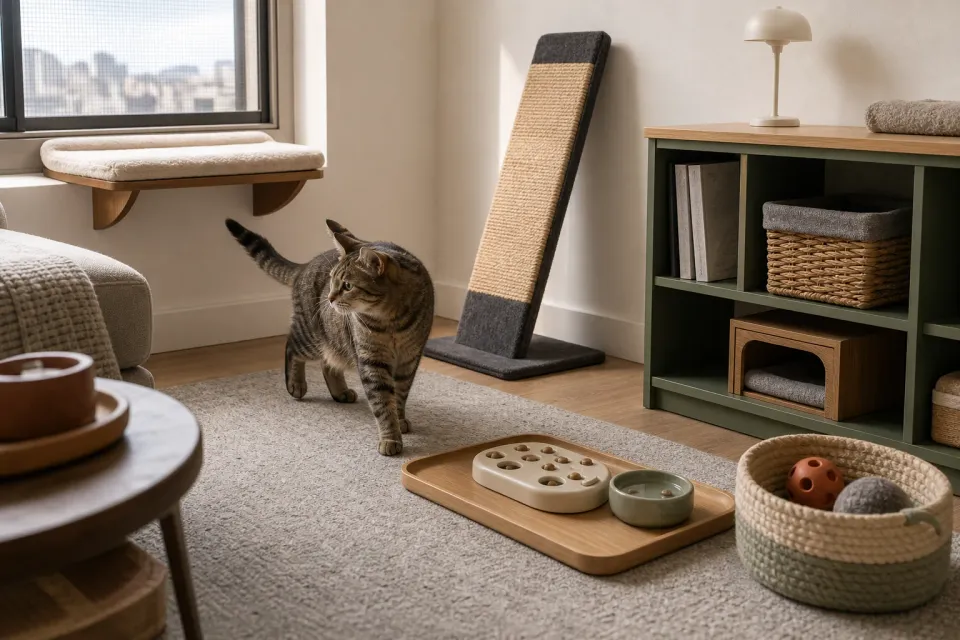
Cat enrichment does not have to mean a living room full of toys, tunnels, towers, and loose cardboard. In many apartments, that approach breaks down fast. The room gets cluttered, the cat ignores half of it, and people start cleaning around objects that no longer do much.
The better version is smaller and more intentional. A few indoor cat enrichment ideas can work hard when they sit in the right daily routes: where your cat wakes, watches, scratches, hunts, eats, and settles. The plan should behave like a rotation system, not a shopping list.
Enrichment is a daily rhythm, not a toy pile
The Ohio State Indoor Pet Initiative describes indoor cat needs around resources, territory, play, scratching, resting, and predictable access. That framework matters because enrichment is not one object. It is a set of chances for a cat to do normal cat work inside a human home.
Normal cat work includes watching movement, stalking, pouncing, scratching, climbing, hiding, sniffing, solving small food problems, and choosing distance from people or other pets. A toy basket in the corner may support some of that, but it cannot replace a room that gives the cat something to do at different points of the day.
Before adding anything, walk the apartment from the cat's height. Where does she pause after waking? Which window has safe movement outside? Where does she scratch now? Where does she hide when the room gets busy? Where can a toy come out for ten minutes, then disappear again? Those answers keep enrichment from becoming clutter.
The behavior signal matters more than the object count. A calmer transition after play, a scratcher used after waking, a cat choosing a perch instead of pacing, or a food puzzle solved without frustration all tell you more than a room full of new supplies.
Keep one active station in each useful zone
Small homes usually do better with stations than with permanent toy spread. A station is simply a place with a job. The window station is for watching. The scratch station is for stretching and scent marking. The food-work station is for slow foraging. The rest station is for quiet retreat.
Each station can be modest. A padded window spot, a stable scratcher, a small tray for puzzle feeding, a cardboard box with two exits, or a shelf route may be enough. The point is not to fill every wall. The point is to place activity where your cat already has a reason to go.
This is where apartment cat enrichment often improves with subtraction. If five toys sit on the floor all week, they become furniture. If two toys appear during play and one food puzzle appears before dinner, they keep more meaning. Novelty is partly timing.
Rotate fewer toys, then make play feel alive
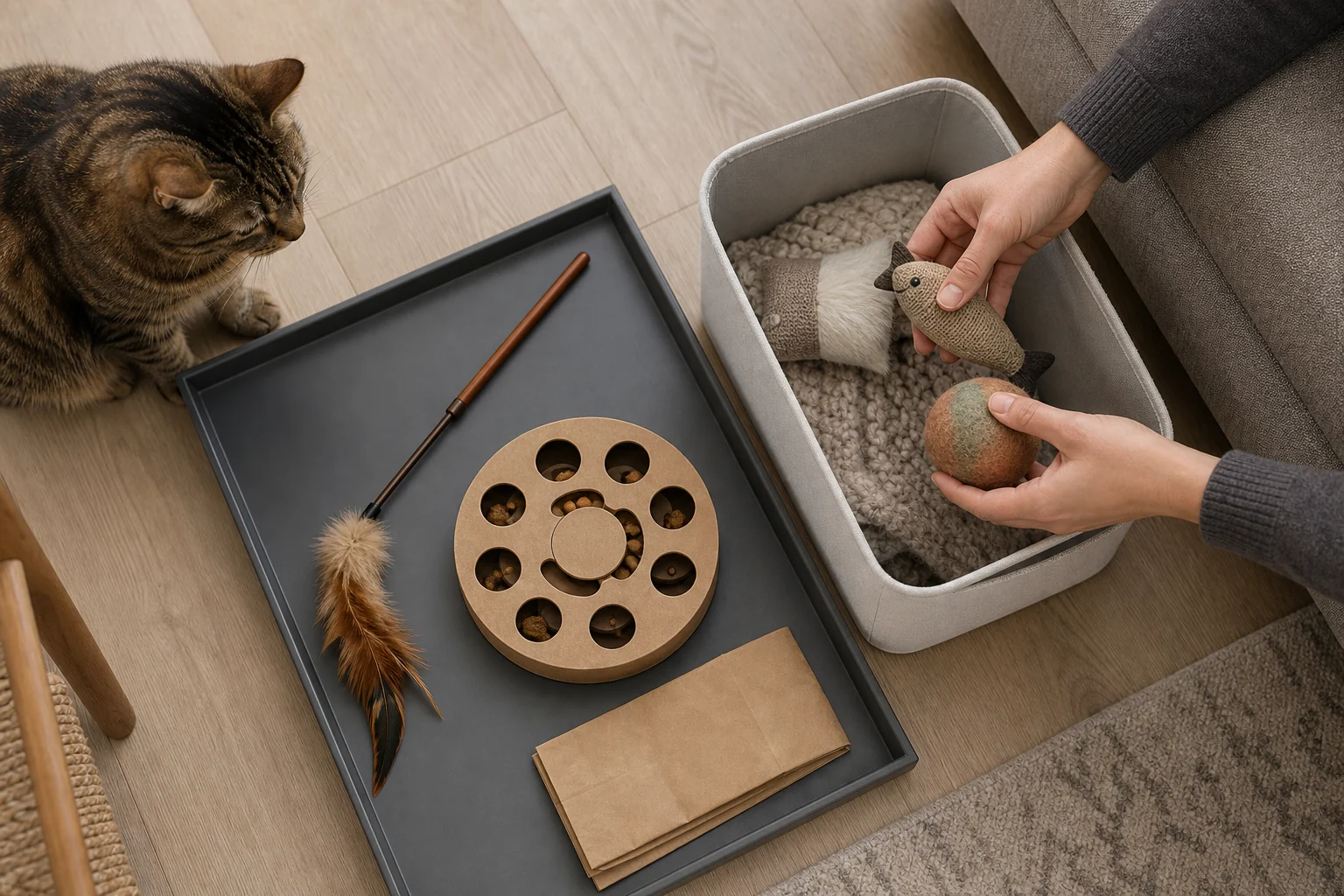
The ASPCA feline DIY enrichment resource points owners toward simple, varied activities instead of assuming enrichment has to be expensive. In practice, the rotation matters as much as the toy. A wand toy that moves like prey for eight focused minutes beats a dozen toys left on the floor for a month.
Keep a small bin out of reach for supervised toys, then choose one or two at a time. Rotate by action, not by color: chase one day, pounce the next, kick, sniff, bat, food-search, hide-and-find. End some play sessions with a tiny food reward or regular meal so the hunt sequence has a clean finish.
Safety still counts. Put away wand strings, feather toys, elastic cords, and small pieces after play. A toy is enriching when it invites safe behavior. It stops being useful if it becomes a chewing hazard or a permanent mess under the sofa.
Food work can use a tiny footprint
Food enrichment is useful because cats naturally work for small opportunities. That does not require a large puzzle tower. A few pieces of kibble scattered on a washable mat, a simple puzzle dish, a cardboard egg carton used under supervision, or a folded towel sniff search can slow the meal and add a little thinking.
Use the cat in front of you. A beginner needs an easy win. Put food where she can smell it and solve it quickly. A cat who loves puzzles can handle more steps later. If a food puzzle causes frustration, pawing, walking away, or food guarding in a multi-cat home, simplify it or separate the cats.
Food work also needs a calorie boundary. Treats and puzzle snacks still count. For cats on a weight plan, use part of the normal meal instead of adding extra food. Enrichment should make feeding more satisfying, not quietly increase the daily intake.
Make vertical space safe before making it high
Vertical enrichment is not about pushing cats as high as possible. It is about giving stable choices: a place to look out, a place to rest above traffic, and a route that does not require a risky leap. The RSPCA cat environment guidance emphasizes safe places, hiding options, and chances for normal behavior. For an apartment, that usually means steady surfaces more than dramatic height.
Check the path in both directions. Can the cat get up and down without landing on a slippery table, loose stack of books, or narrow ledge? Is the window closed and secure? Is the perch wide enough for the cat to turn? Are cords, blinds, plants, and fragile objects out of the route?
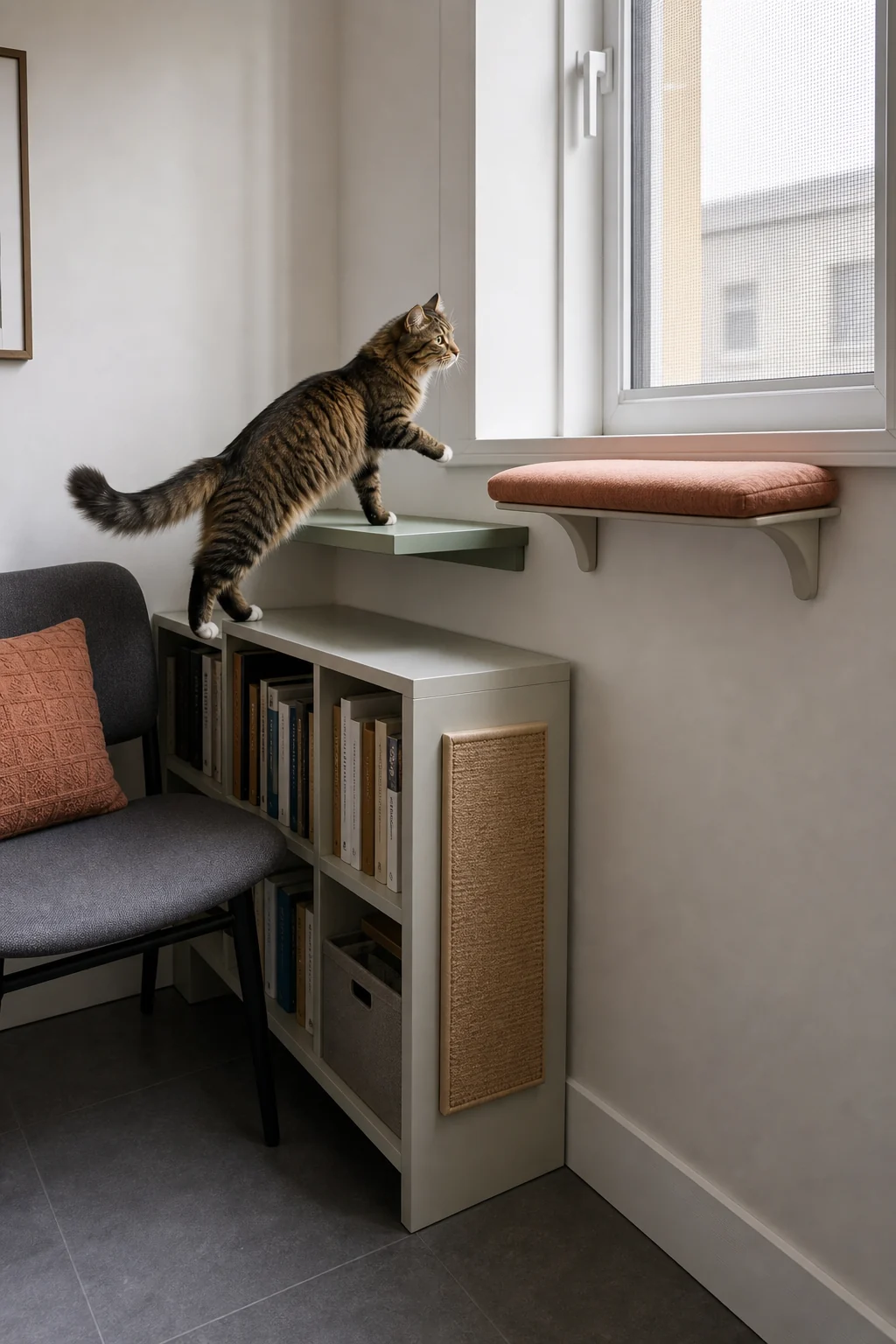
A small window perch can be enough if the path is stable. A bookcase can help if shelves are anchored and clear. A chair can become a step when it does not slide. If the cat hesitates on the way down, the setup is not finished.
Scratching should sit where energy already changes
Scratching is enrichment because it lets a cat stretch, mark, reset, and manage excitement. A scratcher hidden in the neatest corner may save floor space, but it may not meet the cat's actual timing. Put scratching surfaces where the behavior already wants to happen: near a sleep spot, room entrance, sofa route, or play area.
The VCA feline environmental needs guidance includes scratching, play, resources, and safe spaces as part of a cat's home environment. That makes scratching more than furniture protection. It is one of the easiest ways to build enrichment into a room without adding many separate objects.
Use different formats sparingly. A vertical sisal panel, one horizontal cardboard scratcher, or an angled scratcher can tell you what the cat prefers. Once the preference is clear, place the best option on the real route. More scratchers are not automatically better than one scratcher in the right place.
Use scent and sound gently
Not every enrichment idea needs motion. A paper bag with handles removed, a clean cardboard box, a towel that smells like a familiar resting spot, or a short session with cat-safe silver vine or catnip can add novelty without taking over the room. Some cats love scent enrichment. Some ignore it. Some become too excited and need shorter sessions.
Sound and outdoor movement can help too. A secure window view, birds at a distance, passing shadows, or a calm video session can give a cat something to observe. Keep it controlled. If window watching leads to frantic pacing, redirected aggression, or repeated frustration, move the perch, block part of the view, or shorten the session.
The goal is engagement, not constant stimulation. Indoor cats need quiet as much as activity. Good enrichment should give the cat choices, then let her leave.
Design the room so enrichment can disappear
A cluttered enrichment setup often fails because people stop maintaining it. Toys stay out. Boxes collapse. Treat puzzles collect crumbs. The scratcher drifts into a doorway. The cat loses interest, and the room becomes harder to live in.
Build removal into the plan. One basket for supervised toys. One tray for food work. One scratch surface that stays out. One window or vertical route that is always safe. A small home can handle enrichment when each item has a job and a place to return.
That same thinking belongs in broader cat-proof apartment setup. A safe cord route, closed window, clear landing, and washable surface often make the enrichment idea work better than another toy purchase.
It also belongs with broader cat behavior follow-up. Enrichment is successful when it changes the rhythm of the day, not when it photographs well. If a cat becomes more frantic, guarded, or frustrated, the setup needs to get easier, quieter, or more predictable.
A weekly plan is easier than a bigger haul
Try a simple week before buying more. Pick one daily play window, one food-work moment, one scratch station to improve, one window or vertical route to stabilize, and one scent or box session to rotate. Take away what is ignored. Repeat what creates calm engagement.
End the week by removing one thing. That may be a toy that stayed ignored, a puzzle that caused frustration, a box that blocked the room, or a perch that looked useful but created a bad landing. Subtraction is part of enrichment because it keeps the remaining choices readable.
You will know the plan is working when the cat uses the stations without being lured every time. She checks the window, stretches on the scratcher, accepts the food puzzle, joins play, and still has quiet places to rest. That is real enrichment in a small apartment: not more things, but more useful choices in the places your cat already lives.