

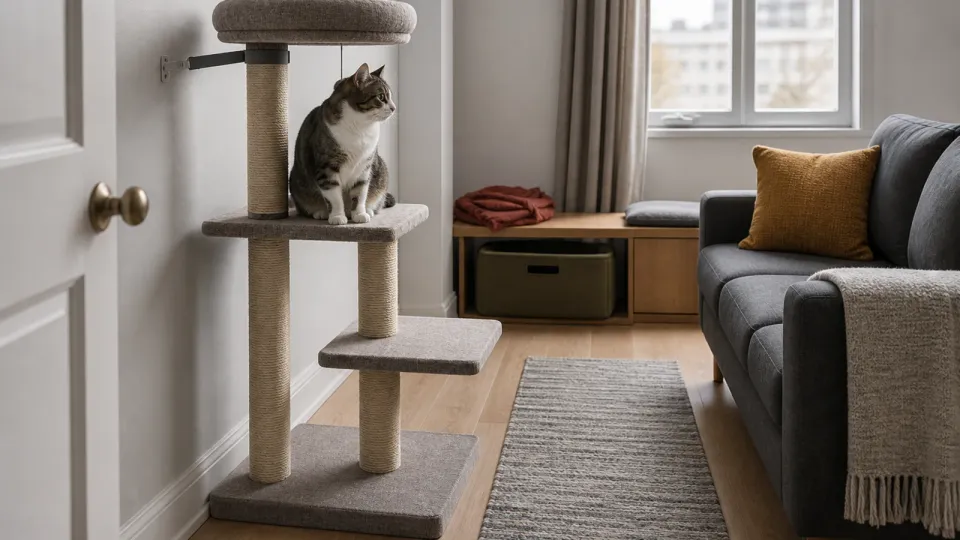
A cat tree is usually bought for height, but it succeeds or fails on placement. A tall tower in the wrong corner can wobble, block the room, trap the cat on a risky landing, or sit so far from daily life that the cat uses it once and forgets it.
When I place a cat tree in a real home, I start on the floor. The base, wall, landing route, window angle, and walking path matter before the top platform does. Good cat tree placement should make climbing feel ordinary: up, turn, watch, scratch, rest, and come down without a dramatic leap.
Put the base where the room can support the height
The safest-looking location is not always the best one. A corner may hide the cat tree, but it may also leave one side unsupported, push the base onto a rug edge, or force the cat to jump down into a narrow walkway. Start by testing the footprint.
Set the tree where the full base sits flat. Avoid half-on, half-off rugs, uneven thresholds, loose floor mats, and spots where a door can hit the platform. If the tree is tall, the wall should help the setup feel stable, even if the unit is not permanently attached yet.
The Ohio State Indoor Pet Initiative describes indoor cat needs around resources, resting places, scratching, play, and territory. A cat tree can support several of those needs at once, but only when it sits where the cat can reach it confidently.
Height is useful only when the tree does not wobble
Most cats want height because it gives a better view and a little distance from traffic. That does not mean taller is automatically better. A medium cat tree with a wide base and wall contact often works better than a dramatic tower that rocks when the cat turns around.
Before encouraging use, press the posts and platforms gently from different angles. Watch the base, not just the top. If the lower board shifts, the top will feel worse when a cat runs up with speed. A wall strap, anchor, or heavier base can help, but it should be installed as a safety feature, not as a way to rescue a poor location.
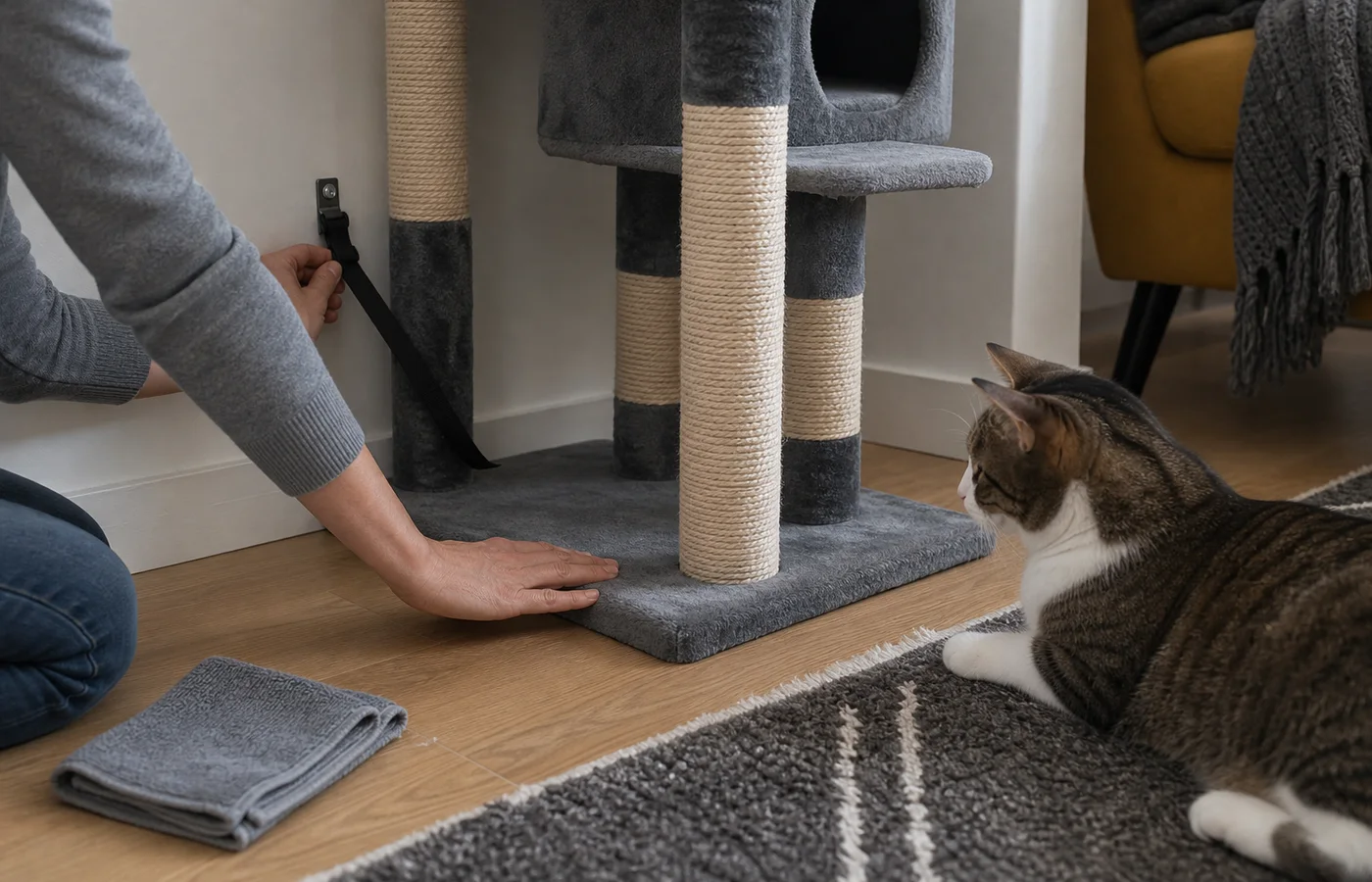
Do not rely on a cat's agility to cover for a loose setup. A cat may still climb an unstable tree, especially if food, a toy, or a window view draws her up. That is not proof the placement is good. It only proves the reward is tempting.
Build a route, not a single tall destination
A cat tree works better when the route makes sense in both directions. The first platform should be easy to reach. The middle level should let the cat pause and turn. The top should not require a blind drop to the floor. If the tree has one impressive perch but no forgiving way down, the room still needs another step.
VCA's resource on making vertical space for cats emphasizes sturdy access to elevated areas. For cat tree placement, that translates into broad landings, non-slip approach surfaces, and a route that does not depend on a running jump.
Look at the route from cat height. Is the first platform near a sofa arm, bench, ottoman, or floor mat? Is there room to land without hitting a coffee table? Can the cat turn on the platform without the tail brushing a lamp or blind cord? The answer should be boring. Boring routes are the ones cats keep using.
Window placement needs a second question
A window can make a cat tree more valuable, but the view is only part of the decision. Ask what the cat will see, how hot the sun gets, and whether the tree blocks the window, shade, or walkway. A tree shoved tight against a window may create a popular seat and a bad landing at the same time.
Use a closed and secure window. Keep cords, blinds, and fragile objects out of the route. If the outdoor view creates pacing, hard staring, or tension with another pet, shift the tree sideways or add a calmer rest option. Window watching should be available, not mandatory.
For broader window and room safety, keep the same mindset used in cat-proof apartment setup: secure the opening, manage cords, protect landing surfaces, and leave a path away from the busy part of the room.
Match platform size to the cat using it
Cat trees often look larger online than they feel under a full-grown cat. A top perch that fits a kitten may become too narrow for an adult cat to turn, curl, or settle. Large cats need wider platforms and lower-risk routes. Senior cats need more steps and less dramatic height.
The RSPCA's cat environment guidance highlights hiding places, resting spots, play, scratching, and safe access as parts of a healthy home environment. Platform size is part of that access. A perch is not a resting spot if the cat has to balance on it.
Watch the body, not the product photo. If the cat keeps one paw on the lower level, backs down instead of turning, crouches instead of resting, or avoids the top except during play, the platform may be too small, too high, or too exposed.
Let the cat tree take one clear job in the room
A cat tree can be a scratch station, window station, retreat, play route, or traffic buffer. It rarely does all of those jobs well in every spot. Pick the main job first, then choose the location that supports it.
Near a sofa, the tree may redirect scratching and give the cat a place to join the room without sitting on people. Near a quiet wall, it may become a retreat. Near a window, it may become observation. In a hallway, it may only become an obstacle unless the base is narrow, the landing is safe, and the cat already uses that route.
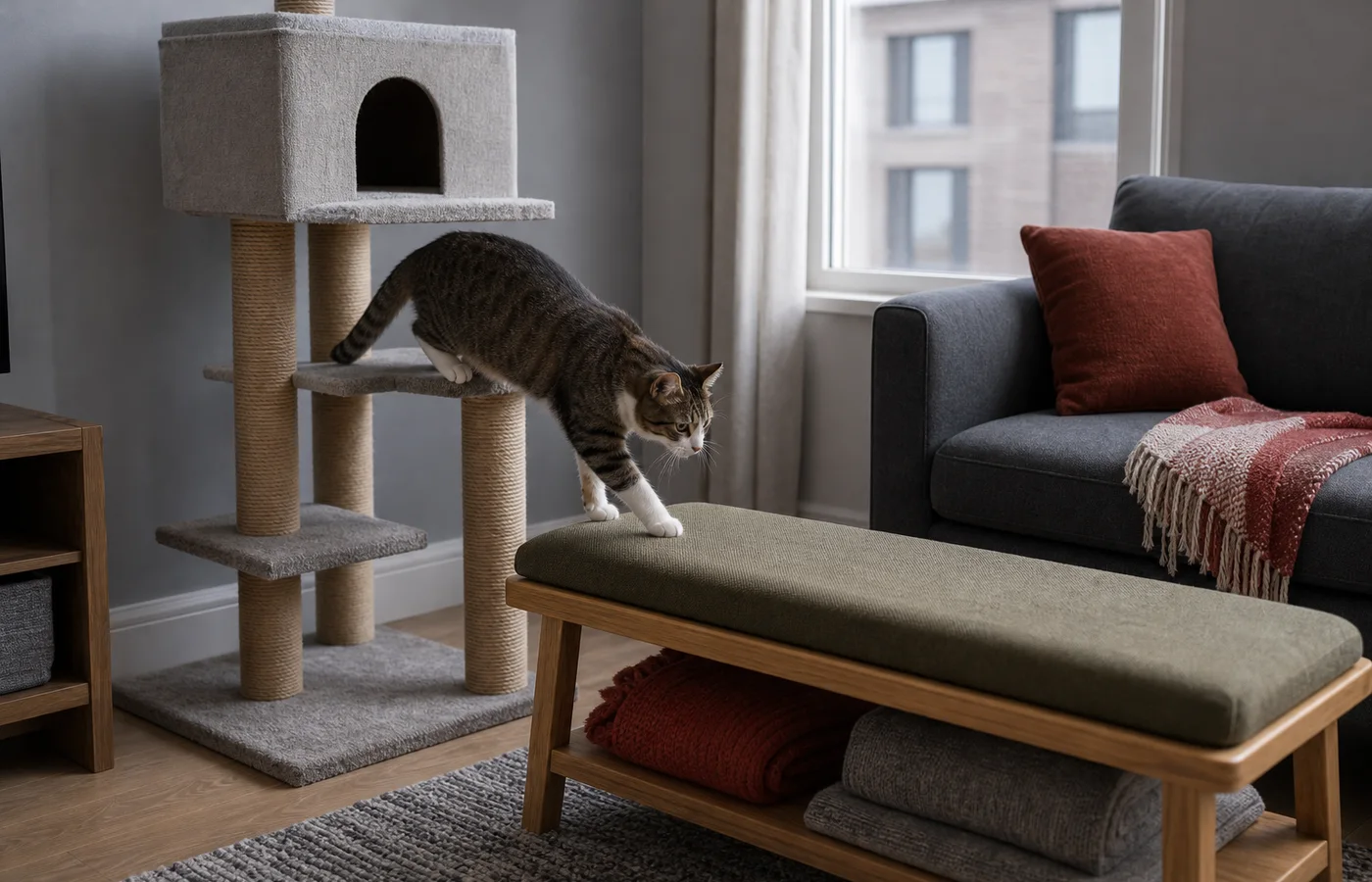
In small rooms, this job-first approach prevents clutter. The tree should not block a litter route, water station, door swing, or the only path around the couch. The same thinking behind a small-space litter setup applies to cat furniture: access and traffic flow decide whether the object stays useful.
Cleaning access is part of placement
Cat trees collect fur, dust, litter granules, food crumbs, and the occasional hairball. A perfect-looking corner can become a bad spot if the vacuum cannot reach the base or the platforms are too close to the wall to wipe down.
Leave enough room to clean around the base, inspect hardware, and rotate cushions or removable pads. If the tree sits near a window, check for condensation, sun-faded fabric, or dusty screen residue. If it sits near a litter area, keep it far enough away that the cat is not carrying grit onto the platforms.
This is also where multi-cat homes need a different eye. One cat can own the top, another can block the lower platform, and a third can be left with no easy route through the room. If the tree creates guarding, add another rest spot or move the tree where exits are wider.
A one-week placement test beats another shopping list
Place the tree, then resist the urge to judge it on day one. Watch the pattern for a week: first approach, favorite level, route down, scratching use, nap use, conflict points, cleaning access, and whether the tree blocks the room.
CatVets' setting-up resource keeps the focus on safe places and predictable resources. That is a useful way to judge the week. The cat tree should become a reliable option, not a novelty object that only works when you lure the cat with treats.
Keep the tree where the cat uses it calmly and the home can maintain it. Move it when the base wobbles, the route is awkward, the sun is too harsh, or the room starts working around the furniture instead of living with it. The right cat tree placement is not the tallest or most hidden spot. It is the spot where height, stability, route, and routine all hold together.