

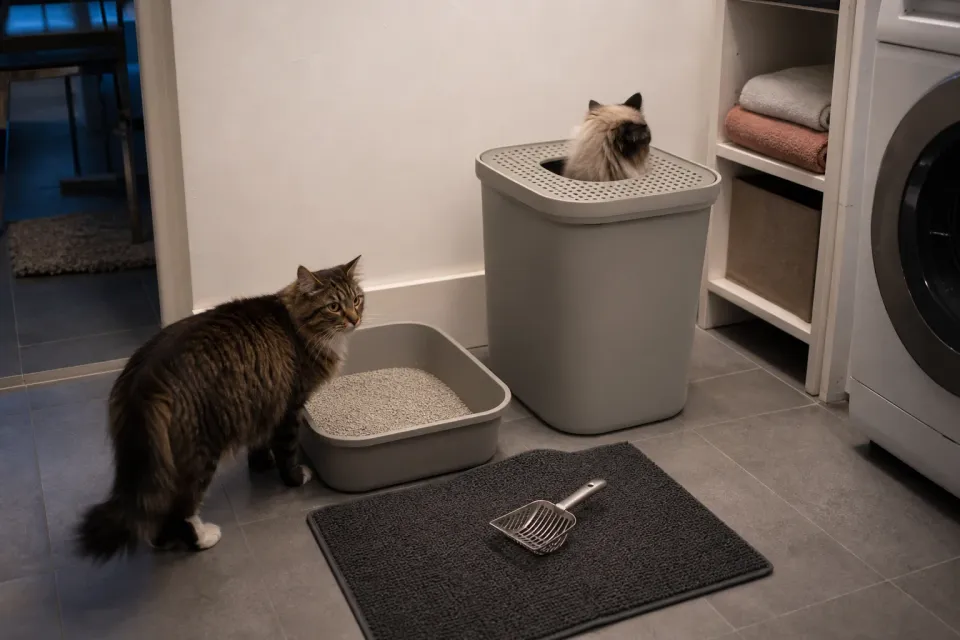
Top-entry litter boxes look like an easy fix for litter tracking. The cat climbs through the lid, steps across the textured top, and leaves less grit on the floor. In a home where litter trails keep reaching the hallway, that sounds useful.
The catch is that the box only works if the cat accepts the climb every single time. A top-entry litter box can reduce scatter and tighten the exit path, but it can also make the bathroom harder for kittens, senior cats, large cats, arthritic cats, and cats who already feel uncertain about the litter area. I would treat it as an access decision first and a cleaning decision second.
The real question is not whether top-entry boxes work
The better question is what problem you are asking the box to solve. If your main problem is a spray of clean litter just outside the tray, a top-entry design may help because the cat has to exit over the lid instead of stepping straight onto the floor. If the problem is dust, odor, urine clumps breaking apart, or a cat avoiding the box, the entry style may not touch the cause.
Merck Veterinary Manual frames litter boxes around access, cleanliness, placement, and cat preference rather than appearance. That is the useful lens here. A tall bin with a lid can be tidy for the room and still be a poor bathroom for the cat.
Top-entry boxes tend to be strongest in three situations: a confident adult cat, a box location with enough landing space, and tracking that starts at the first few steps after exit. They are weakest when the household is trying to hide a box, shrink the footprint, or solve a behavior problem by making the box harder to enter.
Start with the climb, then judge the mess
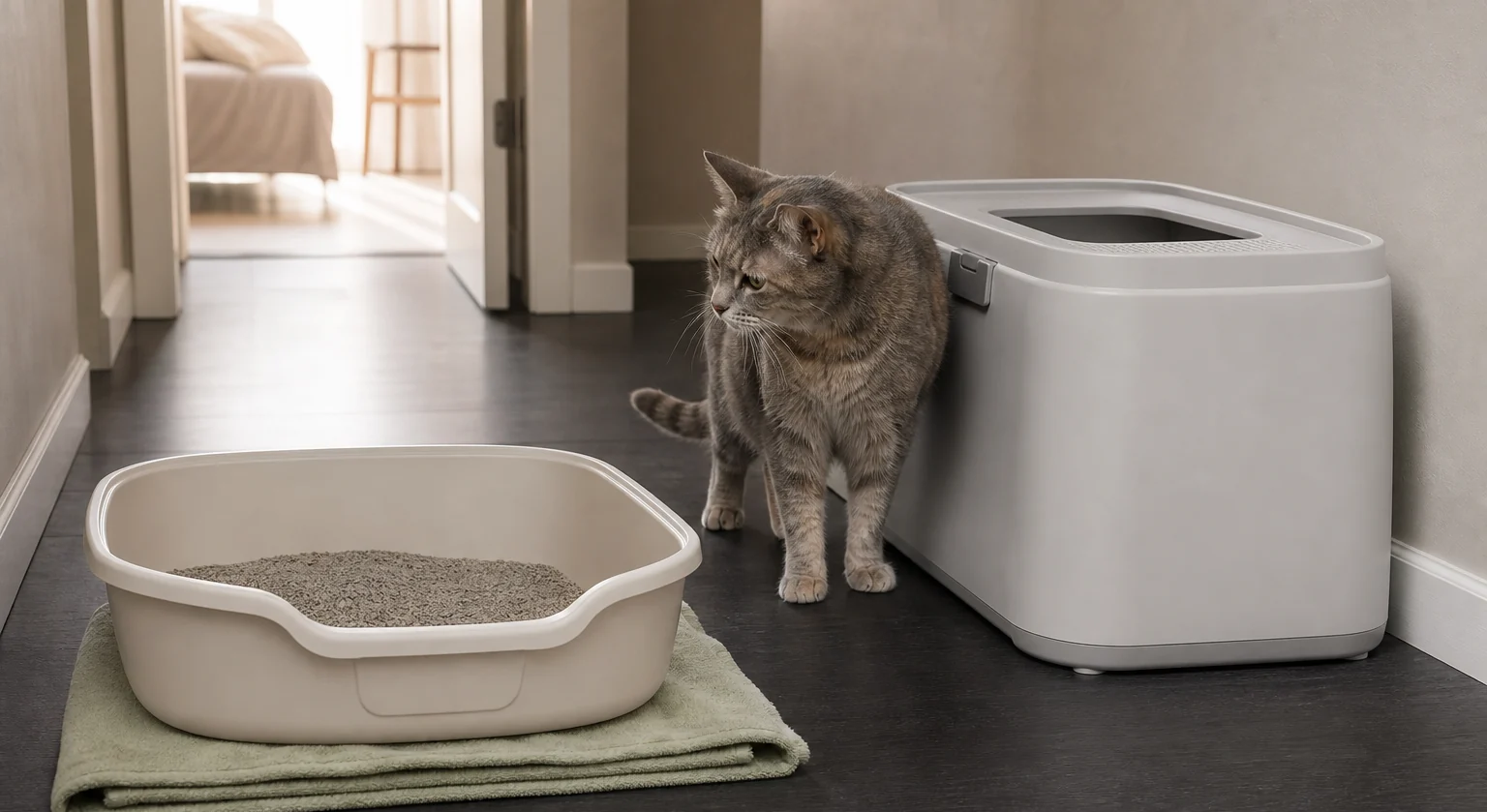
A cat has to do more than step into a top-entry box. She has to jump or climb onto the lid, aim for the opening, lower herself into the box, turn around inside, then climb back out. That can be fine for a healthy, agile adult cat. It is a bigger ask for a cat with sore joints, weak hind legs, poor balance, extra body weight, or low confidence.
The ASPCA litter box problem guidance specifically warns that side or top openings can be difficult for some cats, especially when a cat is older, ill, or physically limited. VCA's arthritis guidance also notes that cats may hide pain and show changes in jumping, climbing, grooming, or litter box behavior. A cat who suddenly dislikes a tall box may not be stubborn; the box may have become hard to use.
That is why I do not like replacing every box in one afternoon. The tracking improvement is not worth it if the cat starts holding urine, choosing rugs, or rushing out because the exit feels awkward. Access is part of the bathroom, not an optional convenience.
Where the tracking benefit actually comes from
The lid can help because it changes the first contact after digging. Instead of stepping directly from litter to floor, the cat lands on a perforated or textured surface that can catch some loose granules. It also narrows the exit direction, which makes the first few feet easier to audit.
That does not make a top-entry box a complete tracking solution. Granules can still cling to paws. Long-haired cats may carry litter in fur. Lightweight litter may bounce farther. A cat who launches out of the opening can scatter litter from the lid to the floor. If your tracking trail is already reaching multiple rooms, also check the mat and exit path before blaming only the box style.
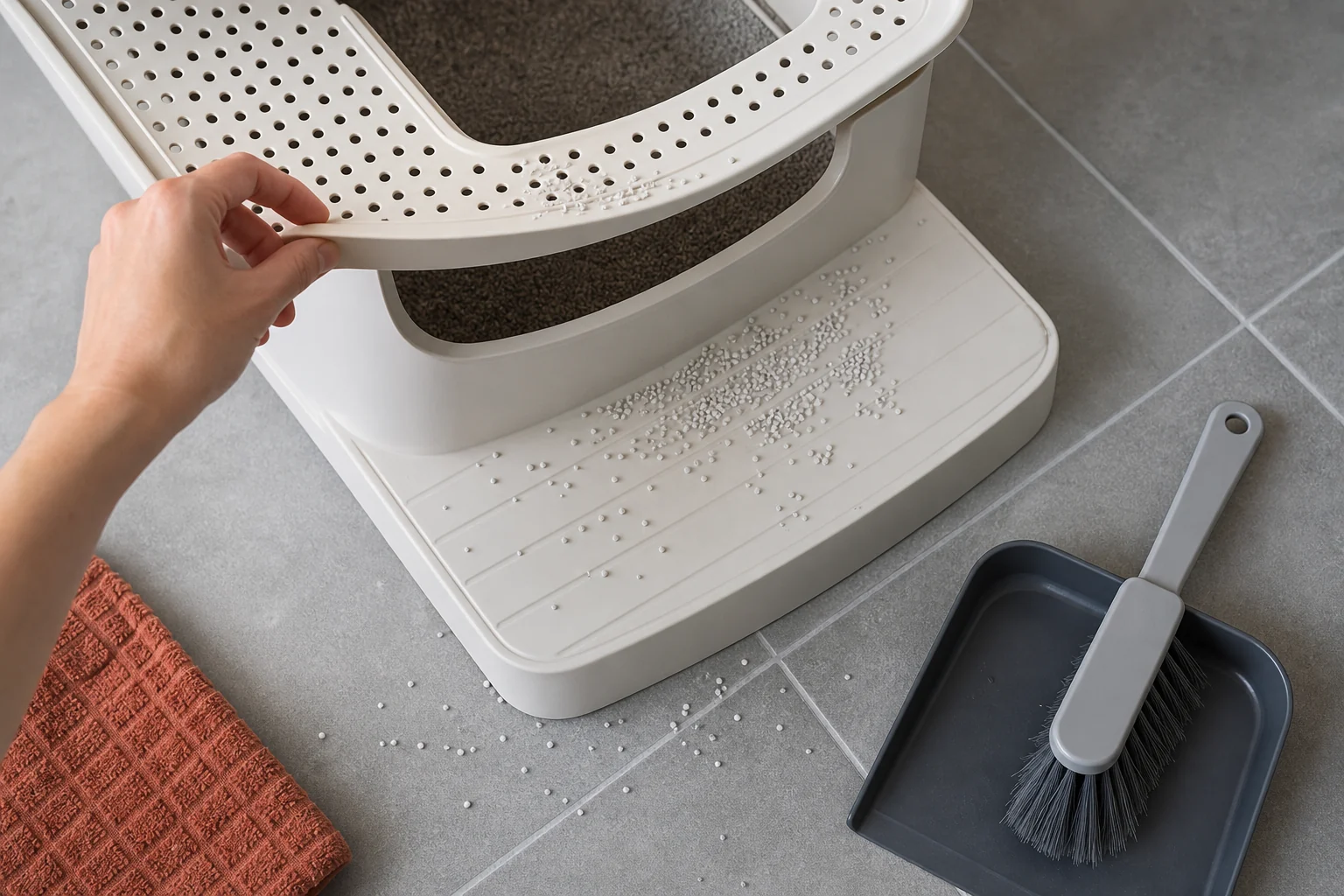
Judge the result after normal use, not right after you vacuum. Sweep the same small zone each day for a week. If the top-entry box only moves litter from the hallway to the lid, that may be a win. If the lid fills with grit and the cat jumps over the mat, the box has not solved the real route.
The inside size matters more than the outside footprint
Top-entry boxes often look compact from the outside because they are tall rather than wide. The cat still needs enough interior space to stand, turn, dig, and posture without folding into a tight corner. A box that seems neat in a laundry nook can feel cramped once the lid, wall height, and entry hole are part of the movement.
The Ohio State Indoor Pet Initiative recommends thinking about litter boxes as key resources that must be easy for the cat to find and use. For a top-entry model, that means checking the whole motion: floor to lid, lid to opening, opening to litter, turn inside, and exit back to a stable landing surface.
Large cats need special caution. A high-walled bin may be tall enough to hide scatter but not long enough for a relaxed turn. If the cat's back brushes the lid opening, tail hits the wall, or paws land half in and half out, you may be watching a size problem, not a training problem.
Run a two-box trial before removing the old tray
The fairest test is boring: keep the old box clean, add the top-entry box nearby or in another good location, and watch what the cat chooses over one to two weeks. Do not let the old tray get dirty just to force a verdict. That only tells you the cat avoided the worse option.
In my notes, the most useful trial is not which box gets a curious sniff on day one. It is which box still gets used after breakfast, after play, overnight, and after a normal cleaning cycle. A confident cat may use the top-entry box for both urine and stool. Another cat may use it only once, then return to the open tray. A third may use it for stool but choose the low tray for urine, which is a signal worth respecting.
If accidents, straining, frequent trips, blood, crying, or sudden avoidance appear, stop treating the box as a product test. The Cornell Feline Health Center emphasizes that house soiling can involve medical, environmental, and behavioral factors. Urinary distress, sudden changes, or repeated misses belong with a veterinarian, not a longer experiment.
A failed trial usually looks ordinary at first
The early warning is not always a dramatic accident. Sometimes the cat stands on the lid and walks away. Sometimes she uses the box only when the old tray has just been scooped. Sometimes the first exit is a launch instead of a step, leaving litter on the lid, floor, and wall because the cat wants out quickly.
That is the moment to listen to the behavior instead of arguing with it. A top-entry box may be tidy for people and still feel costly to the cat. The useful trial question is not "Can the cat physically get in?" It is "Does the cat choose this box when an easier, clean option is available?"
I would rather keep a slightly messier low-entry tray than teach a cat that the bathroom requires a jump, a narrow target, and a rushed exit. Tracking cleanup is annoying. Litter avoidance is a much harder problem.
Placement can make or break the design
A top-entry box needs a calm approach and a stable landing zone. Squeezing it between the washer, trash bin, and a swinging door may make the room look cleaner, but it can turn the climb into an obstacle course. The cat should not have to jump onto the lid while dodging a door, another cat, a storage basket, or a slippery mat.
Covered and top-entry boxes share one risk: people may value concealment more than the cat values comfort. If your reason for the lid is mostly hiding the box, compare that choice with a more open setup in covered vs open litter box. If the room is tiny, the better fix may be a better route, mat, and cleaning station rather than a taller box. Small homes usually need a whole apartment litter setup, not one hidden bin.
Multi-cat homes need another check. One cat sitting near the lid can block access without a fight. Because the opening is on top, the cat inside has fewer escape options than with a wide open tray. If one cat already guards doorways or litter areas, do not make the only bathroom more trap-like.
Who should skip a top-entry litter box
Some cats should probably keep a low-entry or open option, even if a top-entry box would make the floor easier to clean.
- Senior cats: stiffness, weaker jumps, or hidden arthritis can make the lid feel costly.
- Kittens: small bodies and developing coordination make tall entry less reliable.
- Very large cats: the opening and interior turn may be too tight even when the box looks tall.
- Cats with urinary history: easy, fast access matters more than scatter control.
- Nervous or bullied cats: a single top opening can feel like a dead end in a tense household.
- Cats already missing the box: solve medical, cleanliness, placement, and conflict variables before adding a harder entry.
Skipping a top-entry design is not a failure. It is often the cleanest decision. A low-sided open tray with a better mat, a wider first-six-feet route, and a realistic cleaning rhythm may outperform a tall bin the cat only tolerates.
Cleaning the lid is part of the setup
The lid is not just a roof. It becomes a landing mat, a granule catcher, and sometimes a dust shelf. If it is hard to lift, awkward to wash, or annoying to dry, the tracking benefit can turn into a neglected surface. That matters because cats judge smell, footing, and cleanliness more closely than people expect.
Build the lid into the scoop routine. Shake loose granules back into the box if the design allows it, wipe the surface when dust builds up, and wash the lid as often as the rest of the box needs it. If odor is still hanging around after scooping, the next check is not the lid style; it is the odor source around the box, including residue, litter depth, waste storage, and airflow.
Do not store heavy items on top of the box. A top-entry lid should feel predictable under the cat's paws. If it flexes, shifts, rattles, or becomes a shelf for supplies, the cat may learn that the bathroom floor is more stable than the bathroom itself.
The one-week verdict should be simple
After seven ordinary days, the answer should be visible without arguing with the cat. The box is working if your cat enters without hesitation, uses it for normal elimination, exits without rushing, and the trail is meaningfully easier to clean. It is not working if the cat avoids it, uses it inconsistently, jumps out hard, guards or gets guarded at the opening, or starts leaving clues outside the box.
Keep the decision practical. A top-entry litter box is worth trying for a confident adult cat in a home where tracking starts at the exit. It is worth skipping when access, size, pain, fear, or multi-cat tension is already part of the picture. The best litter box is not the one that hides the mess from the room. It is the one your cat can use easily enough that the room stays cleaner because the box keeps getting used.