

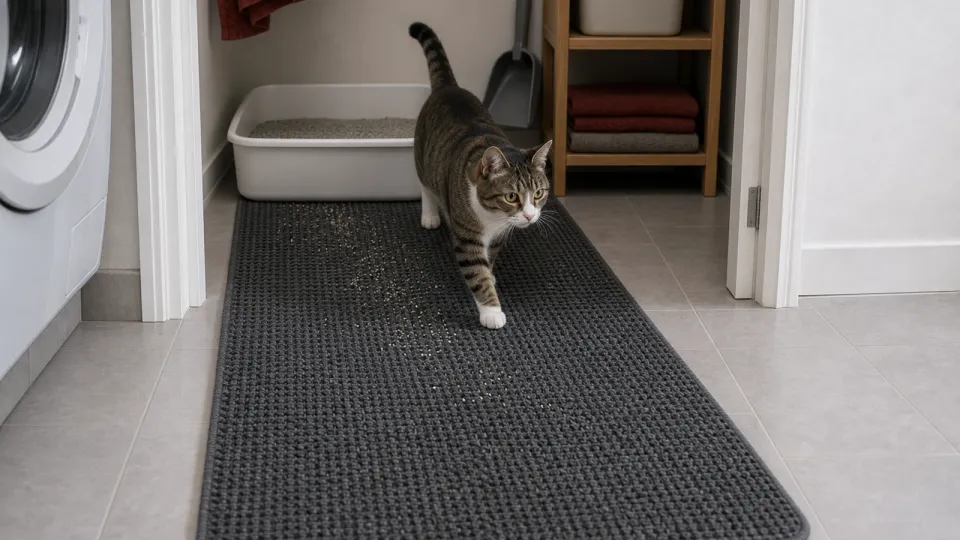
A cat litter mat is useful only when the cat actually walks across it. That sounds obvious, but it is the mistake behind many disappointing mat purchases. The mat sits neatly in front of the box while the litter trail starts beside it, behind it, or three feet away where the cat lands after a jump.
So the better question is not "What is the best cat litter mat?" It is "Where does tracking really begin in this home?" A good mat can catch part of the trail, protect a hard floor, and make sweeping easier. It cannot fix a box the cat rushes out of, a path that misses the mat, a litter texture that clings to paws, or a cleaning routine that turns the mat itself into a dusty surface.
A litter mat starts after the box, not at the front edge
Most people place a mat where the box looks like it has a front. Cats do not always agree. One cat may step straight out. Another may pivot left. A third may leap from the tray to the nearest open floor because the area feels tight, noisy, or blocked.
The Ohio State Indoor Pet Initiative frames litter boxes as basic indoor resources that should be easy for cats to find and use. That matters for mat placement because the mat should support the route your cat already accepts. It should not turn the exit into a narrow obstacle course.
Before buying a bigger mat, watch three ordinary exits. Do not stand over the cat. Just notice the first paw landing, the second step, and the direction the cat chooses when the room is quiet. That small observation usually tells you more than a product photo.
Measure the first three steps
The first three steps after the box are the high-value zone. If the granules mostly fall there, a mat has a fair chance. If litter appears under the dining table, in the hallway, or across a bedroom threshold, the mat may be only one part of a larger mat and exit path problem.
In my litter setup notes, I mark the trail before changing anything. Sweep the area clean at night, then check the floor the next morning before vacuuming. Look for where the granules collect: right at the lip, beside the box, along the walking route, or at a jump landing. The goal is not a perfect floor. The goal is to find the first place where litter leaves the cat.
If the first pile is beside the mat, move the mat before replacing it. If the first pile is on the mat but the second pile starts beyond it, length may matter. If the first pile starts after a jump, the box height, room pressure, or exit angle may be the bigger issue.
Texture catches granules only if paws cross it
Texture is the feature most mat listings emphasize, but texture does not work from a distance. A looped, ribbed, honeycomb, or woven surface can trap loose granules only when paws actually land on it. If the cat steps around the mat, jumps over it, or touches only one corner, the material is not getting a real test.
Texture also changes how a cat feels about the route. Some cats accept a rougher surface without hesitation. Others slow down, shake a paw, or choose the smooth floor beside it. That does not mean the cat is being difficult. It means the mat has become part of the bathroom experience.
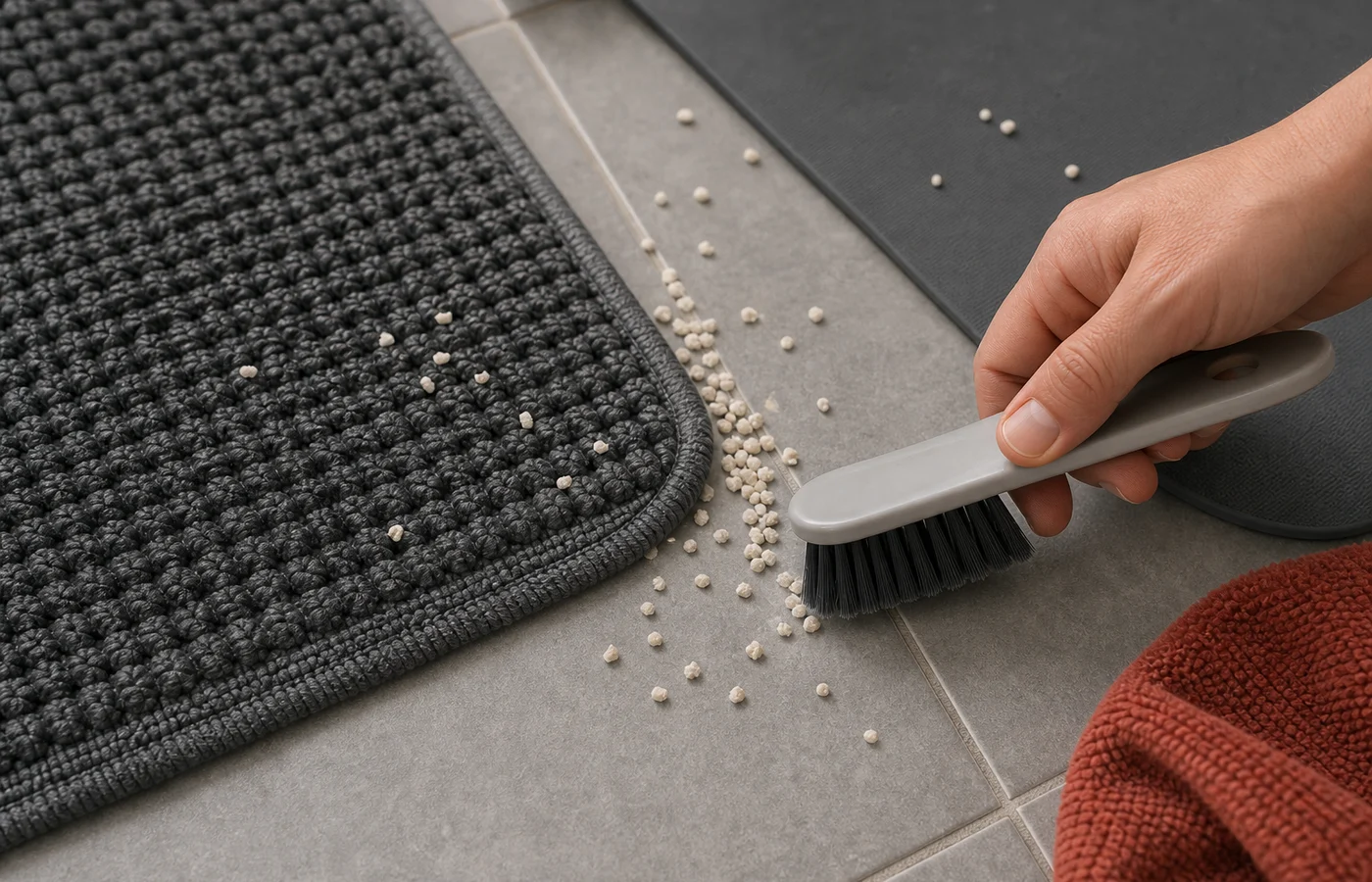
Watch the cat's feet, not the packaging claim. A good texture should slow the trail, not slow the cat. If your cat starts hopping, stretching across the mat, or taking a longer route around it, choose a flatter surface and solve more of the tracking through size and placement.
Bigger is useful only on the real exit path
A larger mat is often the easiest upgrade, especially with an open tray or a large cat. More surface gives litter more chances to drop before the cat reaches the rest of the room. But a bigger rectangle in the wrong direction is still the wrong tool.
Think in path length, not just mat area. A long runner may work better than a wide square if the cat walks straight out. A wider mat may work better if the cat turns sideways, steps around the tray, or exits near a wall. In a small apartment, the best answer may be a mat plus a box rotation, not a mat that blocks the only walkway. Small homes usually need a whole small-space litter setup check, not one oversized floor piece.
Leave enough clear floor that the cat can enter and exit calmly. A mat that curls into a doorway, catches under a door, or slides toward the box can create a new problem while trying to solve the old one.
Edge height can help or become a trip point
Raised edges can hold loose litter and stop granules from rolling across hard floors. They can also catch toes, fold under paws, or become a reason a careful cat avoids the mat. The tradeoff depends on your cat's movement and the floor underneath.
For confident adult cats on smooth tile, a low raised edge may be fine. For kittens, senior cats, very cautious cats, or cats with mobility changes, a flatter transition is usually kinder. The ASPCA's litter box problem guidance treats box setup, location, and cat preference as part of the problem-solving picture. That same logic applies to the surface immediately outside the box.
If a cat pauses at the edge or steps over it like a curb, the edge is not invisible to the cat. Test the mat flat, then test the raised edge only if the cat crosses it without hesitation.
Cleaning friction decides whether the mat stays useful
A mat that is hard to clean becomes a second litter box floor. Fine dust, broken clumps, and damp residue can settle into deep grooves. The surface may still look tidy from standing height while holding smell and grit near the cat's paws.
The CDC's pet supply cleaning guidance is a useful reminder that pet items need real cleaning habits, not just quick cosmetic touch-ups. For a litter mat, that means choosing a surface you will actually shake, vacuum, rinse, and dry on schedule.
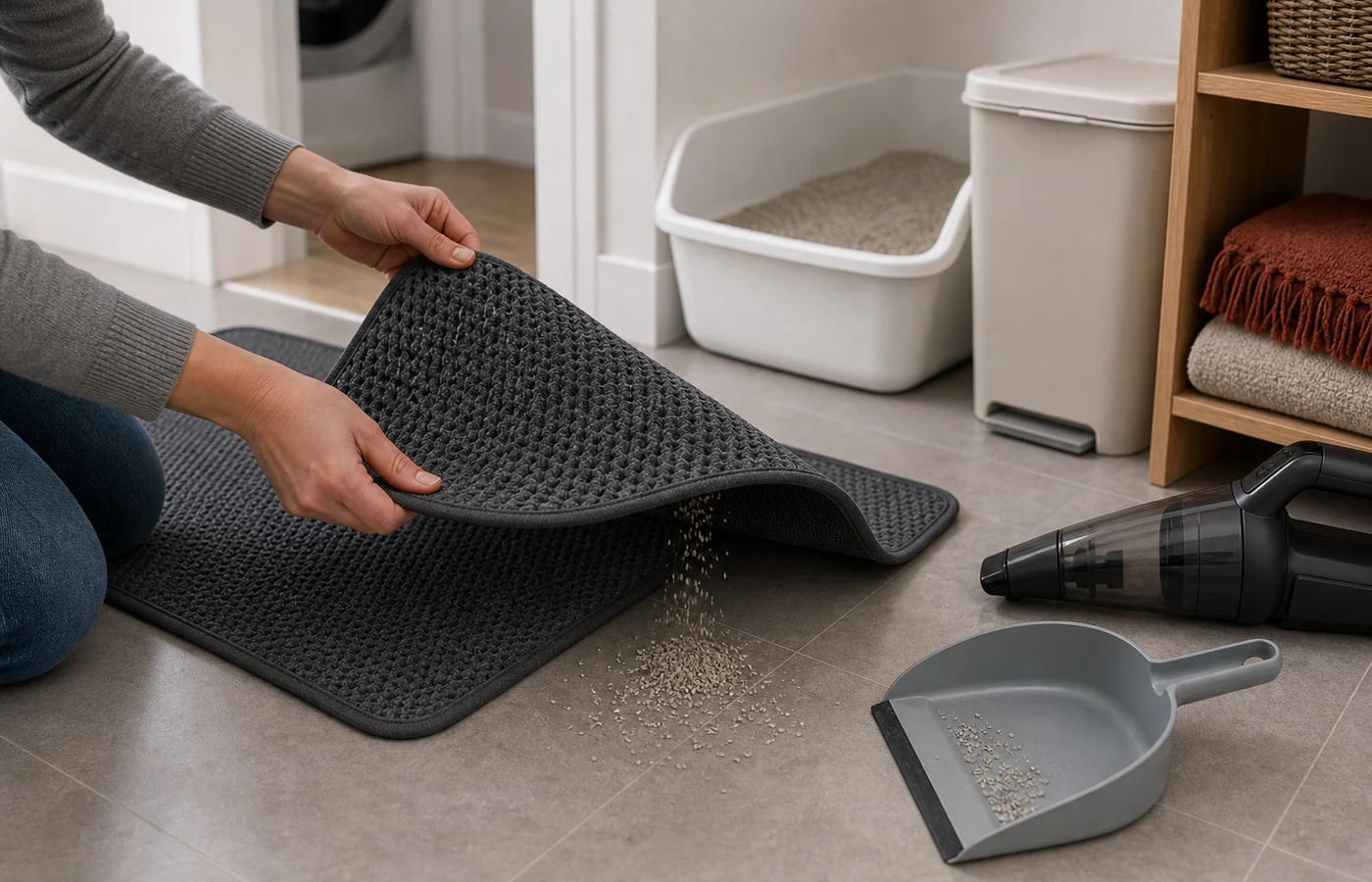
Do the cleaning test before committing. Lift one corner. Does litter fall out cleanly, or does it cling? Can the mat be vacuumed without bunching? Can it be rinsed and dried before the next use? If the answer is no, the mat may be too complicated for the real routine.
If smell lingers even when the mat is clean, widen the audit. The issue may be litter depth, plastic residue, waste storage, airflow, or the box itself. Use an odor source check before blaming only the mat.
Floor type changes the result
Hard floors make tracking visible. Granules roll, scatter, and collect at baseboards. A mat with enough grip can help because the contrast between smooth floor and textured mat is clear. But if the mat slides, curls, or shifts when the cat exits, the cat may avoid it.
Carpet hides the trail longer. That can make a mat seem less urgent, but it also makes embedded litter harder to remove. On carpet, I prefer a mat with a stable backing and a texture that releases litter during vacuuming. A deep surface that traps granules forever is not doing the room a favor.
Tile grout, uneven floors, narrow laundry rooms, and door swings all change the test. Place the mat where it can lie flat and where the cat can cross it naturally. A mat that is half under a door or half curled against the tray will not give you a clean verdict.
Run a three-day mat test
Use a short test instead of guessing. Day one: clean the floor, place the mat on the observed exit path, and leave the rest of the setup alone. Day two: check where litter collects before vacuuming. Day three: clean the mat itself and decide whether the routine is realistic.
Do not change litter, box style, mat, and room layout at the same time. If tracking improves, you will not know which change helped. If tracking gets worse, you will not know what annoyed the cat. One variable at a time gives you a clearer answer.
The mat is working if the cat crosses it normally, the first three steps are cleaner, and the mat can be cleaned without becoming a chore you avoid. It is not working if the cat detours, jumps, hesitates, or if the same amount of litter simply moves from the floor into a dirty surface.
The mat worth keeping changes the route, not the promise
A cat litter mat is worth it when it matches the real exit path, feels acceptable under the cat's paws, stays flat, and fits the cleaning routine. It is not worth much when it is chosen by size chart alone and placed where the cat does not walk.
Keep the verdict grounded in the floor. If the trail starts at the box lip and fades across the mat, you have a useful tool. If the trail starts after a jump or around the mat's edge, fix the route first. The best mat is not the one that looks most technical. It is the one your cat crosses calmly enough for the floor to show a difference.