

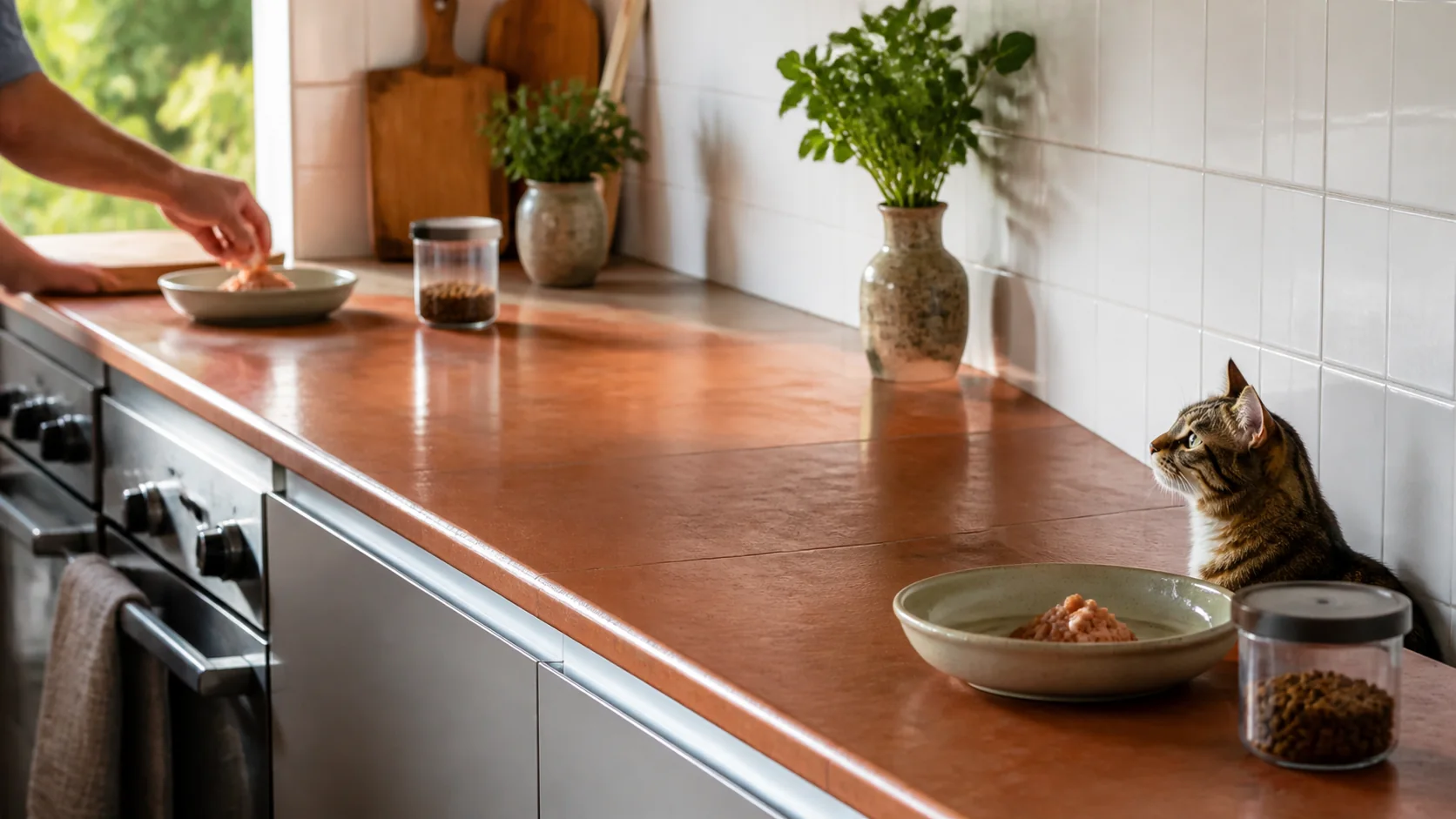
A cat can receive the right amount of food and still have a poor feeding schedule. One person gives breakfast, another assumes breakfast was missed, dry food stays available all day, and the evening meal becomes an extra rather than the second half of a measured total.
How often you should feed a cat depends on life stage, health, food format, individual preference, and what the household can repeat. Meal frequency divides a daily amount across time. It does not create additional calories.
Set the daily amount before dividing the meals
Start with the current daily food plan: which food, how much energy it provides, what counts as treats, and whether a veterinarian has given individual instructions. The label-to-daily-total method handles cups, cans, grams, treats, and mixed feeding. Keep that total stable while deciding when to offer it.
A general calorie estimate can organize a conversation for a healthy adult cat, but it cannot assess body condition, muscle loss, pregnancy, growth, or disease. Kittens, pregnant or nursing cats, cats on therapeutic diets, and cats with diabetes or other medical needs require a plan from their veterinary team.
Once the daily amount is known, place all of it in one container or written ledger each morning. Every meal comes out of that total. This simple boundary prevents a four-meal schedule from becoming four full portions.
Age changes the starting rhythm
Kittens have small stomachs and high growth demands, so their food is commonly divided into more frequent meals. Cornell's feeding-frequency guidance describes three meals a day as a common pattern up to about six months, twice daily from six months to one year, and once or twice daily as appropriate for many adult cats. Individual health and preference still matter.
Senior cats do not automatically need more or fewer meals because of age alone. Dental discomfort, appetite change, weight or muscle loss, medication timing, nausea, or a medical diet can alter the plan. Those changes belong with a veterinarian rather than a household experiment.
Keep growth-stage food and meal instructions visible when several people care for a kitten. A schedule that exists only in one person's memory is easy to double.

Choose a pattern that survives the weekday
Most homes need a rhythm that still works when someone is late, a meeting runs long, or the evening becomes busy. Three patterns cover many ordinary situations.
Two observed meals
A measured morning meal and measured evening meal make appetite and leftovers easy to see. This can work well for many healthy adult cats when the total and timing are consistent. Pick times the household is normally awake and present rather than chasing a perfect twelve-hour interval.
Several smaller meals
Dividing the daily total into three or four meals may suit cats that prefer smaller servings or homes using planned enrichment. The extra events require a clear ledger. Wet food also needs safe handling; an uneaten portion cannot simply sit until the next scheduled meal.
A measured grazing window
Leaving a known dry-food allocation available may work for some cats, but free access makes intake harder to read and can allow overeating. Cornell notes that grazing is acceptable for some individuals and unsuitable for others. Replace old food daily and measure what is offered and what remains.
Wet food puts a handling limit on the clock
Wet meals should be sized for the cat to eat within a reasonable serving window, with leftovers handled according to the package and food-safety instructions. Splitting one larger container across meals requires prompt refrigeration, clean utensils, and a covered container. The wet-and-dry allocation can keep both formats inside one total.
A meal schedule is not permission to leave wet food at room temperature for hours. When nobody can serve the next wet meal safely, adjust the timing, use an appropriate supervised setup, or arrange for a person to visit.
Multi-cat homes need visible individual intake
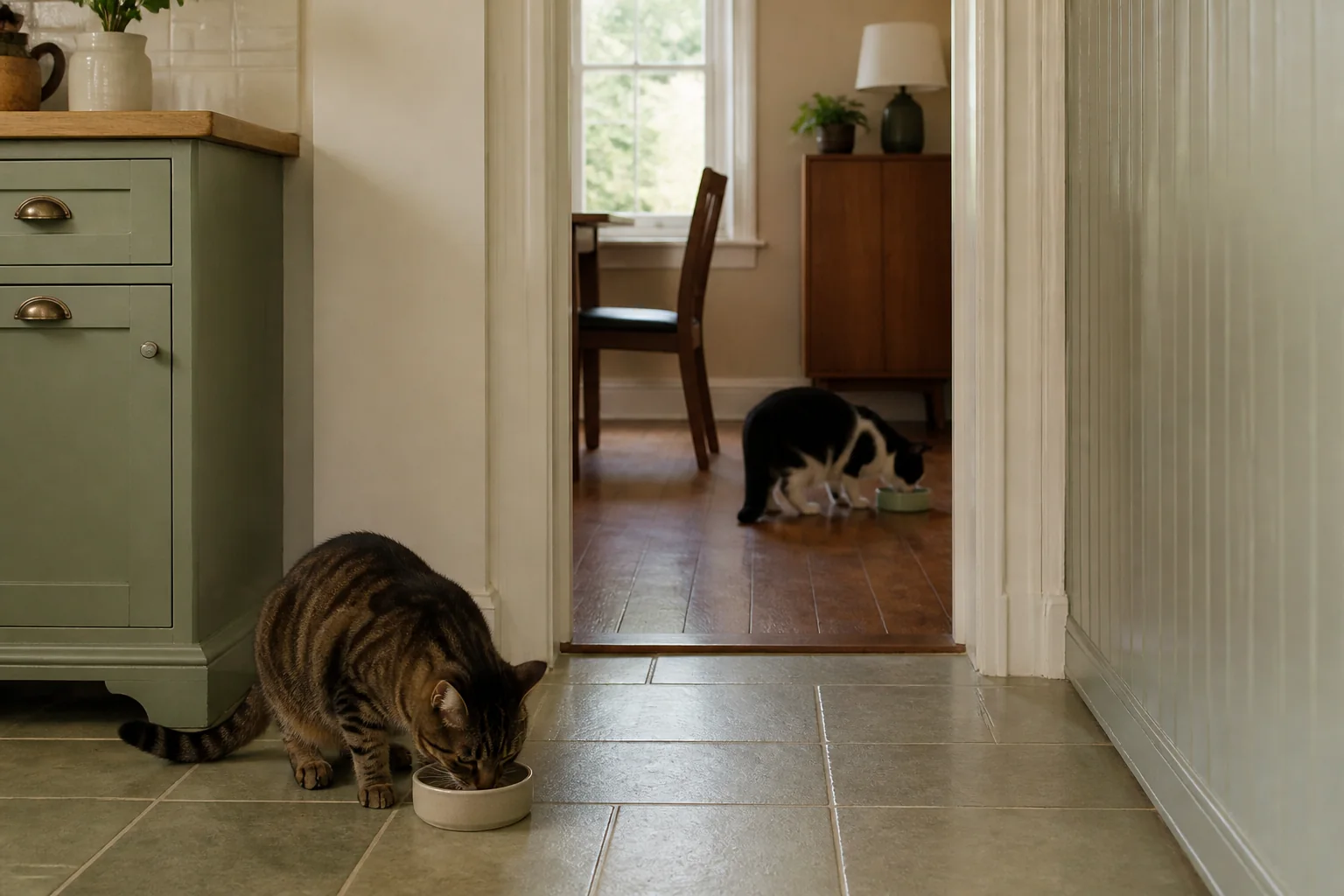
A shared bowl can make a schedule look consistent while one cat eats most of the food. Feed in separate rooms, across a doorway, or at stations far enough apart that each cat can settle without watching the other. Pick up leftovers before opening the spaces again when food stealing is a concern.
FelineVMA's Cat Friendly Homes resources recommend predictable meal times and individual bowls in multi-cat households. Separation also helps the owner notice a missed meal, a slower eater, or an abrupt appetite change.
Automatic feeding still needs a person and a test
An automatic feeder can divide measured dry food into small events, but the machine cannot confirm that the intended cat ate, detect every jam, refill water, clean a dirty bowl, or respond to illness. Test the exact food and portion mechanism while someone is home.
The weekend feeder test covers portion accuracy, power, jams, cleaning, cat response, and backup plans. Use it to support a known feeding schedule, not to invent one around the device.
Write the handoff in portions, not vague meal names
“Feed dinner” is not enough when different people use different scoops. Write the food, amount, meal window, treat allowance, leftover rule, and who marks the meal complete. For mixed feeding, state how much wet and dry food belongs in each event.
A small dry-erase note or shared phone note can prevent duplicates. Keep the measuring tool with the food, and use the same scale or cup each time. At the end of the day, the container or ledger should reconcile to the established daily amount.
Appetite matters more than schedule perfection
Record what the cat actually eats, not only what was served. A cat that suddenly skips a meal, eats much more or less, loses weight, vomits repeatedly, develops diarrhea, drinks noticeably more, or behaves differently needs veterinary attention. Do not keep moving mealtimes in an attempt to hide a persistent appetite change.
Cornell's nutrition overview stresses appropriate complete and balanced food and veterinary help when a cat refuses food and loses weight. Timing is one part of feeding; health remains the larger context.
Build one ordinary Tuesday
Choose a normal weekday and place every meal, treat, and refill on it. Confirm who is home, which food can be handled safely, where each cat eats, and how the household records completion. Run that schedule for a week before adding more complexity.
The useful answer to “how many times” is not the largest number a household can arrange. It is the smallest clear routine that delivers the right daily total, lets each cat eat without pressure, reveals appetite changes, and still happens when Tuesday is busy.